There is an urgent need for healing the divisive separation of people, societies, and nations. A continuation of the present intentional and unintentional “fractionation” forebodes a tragic future. Humans and the institutions they have created for collective living, now threaten life and lives as they assert selective group domination and control. While unity should be an aspiration, population “fractionation” across virtually every societal status marker is producing chaos and havoc. “We reap what we sow.”
“Fractionation” among population sectors across the world has brought widespread local, national, and international violence, conflict and destruction. Toleration of separation, division, and detachment for selected population sectors has promoted a cascade of “populist” ideologies, now threatening to destabilize existing social, political, economic, and moral orders. While these orders have often failed in their expected noble purposes, and while they are now the very seeds of narrow xenophobic and rabid nationalist “populist” movements, it is essential responses be guided by principles promoting justice and equity.
Brexit, Trumpism, and scores of similar populist movements across the world are promoting intense “nativist-alien” competitions for power. The fate of entire nations (e.g., France, Spain, Germany, Hungary, Poland) is now in play. Widespread fears, anger, and rage are endemic in populist movements. Globalization is considered the fault and the enemy.
2. Hegemonic Globalization
Rather than globalization, however, “hegemonic globalization,” or globalization controlled by a few powerful nations (G-8; G-20) may be the source (Marsella, 2005; 2012; 2017). Hegemonic globalizations legitimized USA global dominance and a unabashed freedom to invade, occupy, and exploit nations across the world. As this unbridled foreign policy proceeded, the Middle-Eastern and West Asian regions brought mass documented and undocumented migrations of refugees and immigrants seeking relief from civil wars in Iraq, Syria, Libya, Turkey, Nigeria, Congo, and other African nations, and “terrorist” assaults in Afghanistan, Pakistan, and Bangladesh.
“Hegemonic globalization” ignores and silences, the “common good.” In contrast to “hegemonic globalization,” the “common good” is driven by equity, equality, democracy, and human and nature rights. “Hegemonic globalization” favors a homogenized global community, subservient to special interests and exploitations, serving wealth, military power, and position. Never before has the term “One World” become such a danger!
In the struggle against the pernicious consequences of “hegemonic globalization,” there must be a commitment to the “common good.” “Common good” must become the global goal. The word “common,” itself speaks against fractionation or separation. Interdependency is an unavoidable reality. Even as the risk of “Black Swan” events remains, efforts must be made to develop principles for arbitrating policies and actions insuring the “common” good will trump fractionation. This is the reality!
Opportunistic foreign policies by USA and NATO powers, produced massive national upheavals in identity, and facilitated “fractionation” within and across population sectors. As easy solutions to the problems fell beneath the failed recognition of the complex consequences of intrusions and forced regime changes favored by the USA and its allies, the notion of “endless war” emerged. As usual, these nations concluded their errors revealed the dangerous state of our world, an assertion requiring more global violence, conflict, and destruction, a tragic position favoring only warmongers rooted in government, corporate, and military positions.
Whether by choice, intention, or diabolical impulse, population sectors identified as “different” by status markers (e.g., religion, race, gender, age, gender preference) have emerged as threats, dangers, or risks to the existing status quo. Tragically, the status quo, through media and educational controls, nurtured myths of its “benign” status.
Manichean distinctions became popular among politicians, generals, and war industry mavens. “You are either with us, or against us!” Really! How many Cowboy and Indian movies generated that distinction? Did anyone ever ask the Indians? This in a world of massive population differences! Simplistic solutions from simplistic minds failing to grasp the reality of imposing prejudicial solutions on a world now tired of Western exploitation and dominance, the consequences which now are destroying the West from within!
Unfortunately, possibilities of good, positive, and virtuous changes are denied in the West amid nostalgic calls for a return to the familiar past in which colonization, imperialism, invasion, regime change, labor and resource exploitation, and pollution of the world became rampant. Whether in Africa, Central America, South America, West Asia, or in oceans, earth, and skies, “fractionation” has been the consequence of “hegemonic globalization.” We reap the legacy!
3. Change as Enemy
Change itself has become the enemy! Population sectors considered “carriers” or emblematic of differences have become targets by closed minds who have failed to understand their own egregious role in producing difficulties. The cries of the old status quo echo:
“Remember the “good ole days,” when “men were men,” and you knew what was right and wrong! Remember when we used “bathrooms based on our genitalia,” and our genitalia were sources of pride.” “Men and women knew their place, and foreigners worked their butts off for $3.00 hour plucking chickens, harvesting vegetables, and picking up garbage. Sure do miss those days!”
Many population sectors, however, did not miss those days, and they fought and struggled to change them because of exploitation and abuse. Racial and gender revolutions of past decades, seeking a modicum of equality and opportunity, became labeled as Communist-inspired conspiracies, insidiously inserted into existing stable societies and nations. Unions were considered problems because they pursued equality. Unions, once a voice for workers, became sources of trouble in businesses, schools, and harvest fields.
“We are being screwed!” became the cry! “Take back our society!” “This is not my nation!” “Get out!” In the confusing haze of change, governments, corporations, military, and educational institutions became tyrants oppressing change. Populism became the only salvation for many filled with discontent, fear, and anger.
Ultimately, whether for political, economic, and/or moral reasons, “demonized” population sectors are now being forced into past marginalized statuses. “Fractionation” is omnipresent. Without Constitutional, legal, or moral protections, marginalized population sectors become easy targets for blame ostracism, and justifiable violence. Tensions mount as dominant societal sectors seize power and impose barriers and burdens upon marginalize sectors. “We want law and order!” “We have a right to carry guns anywhere, all the time. Remember the OK Corral?”
In its extremes, ethnic cleansing, genocide, imprisonment, and other forms of social ostracism and isolation become consequences of seemingly “just” effort to protect society. Tragically, the concentration of wealth, power, and position in the minds and hands of a few seeking to perpetuate a past enabling them to maintain positions of power and influence limits and prevents rising protests among marginalized populations sectors (e.g., women, race, gender preference, immigrants, peaceniks, and the elderly).
It is essential concepts and principles for “arbitrating” the “common good” be identified and applied to proliferating local, national, and international policies, regulations, and laws. The latter are seeking to increase separation under nuanced and ambiguous terms. Spin!
Foreign Policy Bias
Monopolistic concentrations of economic, political, social, and ideological power across the world today assure “hegemonic” control (e.g., Big Ag, Big Media, Big Pharmaceuticals, Big Military, Big Education, Big Business, Big Medicine) (see Marsella, 2015). This concentration shapes government foreign policy actions resulting in invasions and occupations destroying national histories, traditions, religions, stability, and identity.
Within this context, “regime-change” has become a reflexive foreign policy option for the USA and allied Western powers. Consider the vast destruction of Middle-Eastern nations (e.g., Iraq, Libya, Tunisia, Syria, Egypt, Yemen, Afghanistan, and likely, soon Turkey and Iran). These nations are “imagined” threats to USA, UK, and Israel hegemony and imperialistic ambitions. In the foreign policy room, however, “imagined” has become real as the perpetrators have forced justification of destruction and war. “Bomb them, accuse them, vilify them, demonize them, and eventually they will respond with anger; at that point we have them where we want them and we can run rampant over them.”
FRACTIONATION: FEAR OF DIFFERENCES
1. Diversity
The issue of “fractionation” is rooted in the contentious ideas and ideologies of diversity, political correctness, and multiculturalism. The world is caught in pressures for cultural and national homogenization versus multiculturalism (e.g., Marsella, 2016). Many government, corporate, and military power sources seek homogenization, because the uniformity will assist in control and domination.
Tragically, “fractionation” is a social, political, economic, and moral distinction and discrimination rooted in differences and diversity. Diversity is the essence of life itself! Diversity reflects the life impulse; the infinite impulse to evolve alternatives.
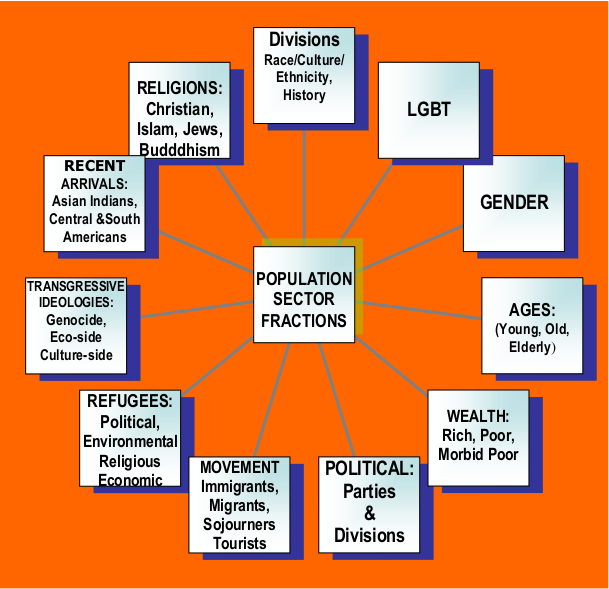
Chart 1 displays examples of population sector “fractionations.” Current political movements directed toward electing or imposing “conservative,” “neo-cons,” “right wing,” and “fascist” governments and national identities are omnipresent. “Fractionation” is strengthened by competition for limited resources (e.g. financial, education, health). There is a need for justice; not only the perception of justice, but an accepted and established template for arbitrating policies and practices.
Chart 1: Examples of Fractionation Sectors
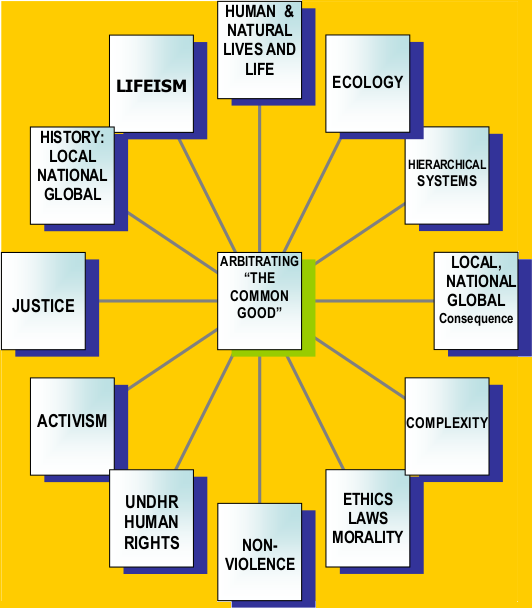
Chart 2 lists proposed concepts and principles for arbitrating public and private policies and actions for the “common good.” Chart 2 concepts and principles are founded within the recognized need for compromise and acceptance rather than imposed force. The issue of “diversity,” so apparent in Chart 1 on “fractionation,” is best resolved, not through “power” politics, but through establishing an equal playing field. How much diversity can a society or nation take before it looses coherence and the ability to function as a whole? The answer is both complex and simple.
“A society or a nation can tolerate as much diversity as it is willing to establish equal opportunities for access to shared society or nation rewards.”
Arbitration principles and concepts displayed in Chart 2 are well known. The challenge is to use them. Consider the reality that science, religion, philosophy, and all other anchors of moral codes speak of these principles on a near daily basis. They are no longer sources of debate, but rather sources of hypocrisy. The world agrees “justice” is essential in arbitrating legal and regulatory policies and procedures, but “justice” becomes ignored by the time its meaning is tarnished through debate and argument, especially at the hands of those who value injustice.
Chart 2: Principles for Arbitrating “Common Good”
Institutions and professions speak daily of ethics and moral codes, and yet they fail to se human rights as the foundation of any ethical or moral code they advocate. Why not begin with the United Nations statement on “human rights?” This universal statement, UNHCR should be read by all professions and specialty services; it should be read by school students either before or after the various pledges of allegiance. Will this provoke controversy and discomfort? Yes, of course, but political and religious codes and pledges are at best attenuated to an institution’s favor.
Or consider “complexity!” Rather than propose simplistic solutions favoring a particular positions or group, acknowledge the situation is complex and will require a consideration of the many complex variables needing to be considered, and appropriate multidisciplinary models. What about “activism?” While authorities seek to contain activism, and even to label it as a crime or terrorism, fundamental principle of citizen activism is enshrined by law and history. Repression of activism rights and privileges to offer counter opinions and to protest is the hallmark of fascism. Addiction to control and dominance in fascism destroy the human spirit and erode choice.
These principles for arbitrating the “common good” stand as a bulwark against the forces of fractionation. When these principles are advocated and used, the “common good” will survive and thrive.
CLOSING THOUGHTS
The challenge of addressing “fractionation,” is in essence, simple. As Sister Joan Halifax said, “There is no other!” There is only one. Addictions to actions and policies of “separation” represent a pull from primitive instinctual impulses when recognition of differences were considered essential for survival. This was a need in ancient times when perceived differences were considered sources of risks and threats to security and survival. But that was then, and this is now! Evolution has demonstrated primitive instincts can yield to reason. Recognition that “differences” are, in fact, expressions of essential evolutionary life expressions is gaining acceptance.
The cosmic principles of “fission” and “fusion,” which characterize and describe the very creation and evolution of the universe itself, contain the message:
“Separation is essential. It offers variations and differences. At the same time, fusion of connection and unification of differences is also essential because the fused creation contains emergent properties yielding yet new opportunities for creative evolutionary possibilities.”
That is life! It is time to accept a new code: “Lifeism.” (Marsella, 2011). To do less, guarantees destruction. To life!
ENDNOTES
“Globalization” is the process and product of transnational and trans-border policies in communication and information technologies; financial transactions and controls; social, economic, and political dependencies; military pacts and alliances; laws; treaties, transportation; and mega-corporations (Marsella, 2012, 2017).
REFERENCES
Marsella, A.J. (2005) “Hegemonic” globalization and cultural diversity: The risks of global monoculturalism. Australian Mosaic, Volume 12, #4, 15-22.
Marsella, A.J (2011). Identity beyond self, culture, nation, and humanity to “lifeism.”
He is known nationally and internationally as a pioneer figure in the study of culture and psychopathology who challenged the ethnocentrism and racial biases of many assumptions, theories, and practices in psychology and psychiatry.
In more recent years, he has been writing and lecturing on peace and social justice. He has published 15 edited books, and more than 250 articles, chapters, book reviews, and popular pieces.
[themify_quote]More than Nations . . .[/themify_quote]
Contrary to the widespread myth, nations are not the sole source of massive international political, economic, and social international events, forces, and changes. It is true the story of history is often told with nations as the grand hand behind unfolding events. Reality, however, is very different. Nations are merely one player among many players shaping history each day amid a complex crucible of “games and gambles” serving many interests.
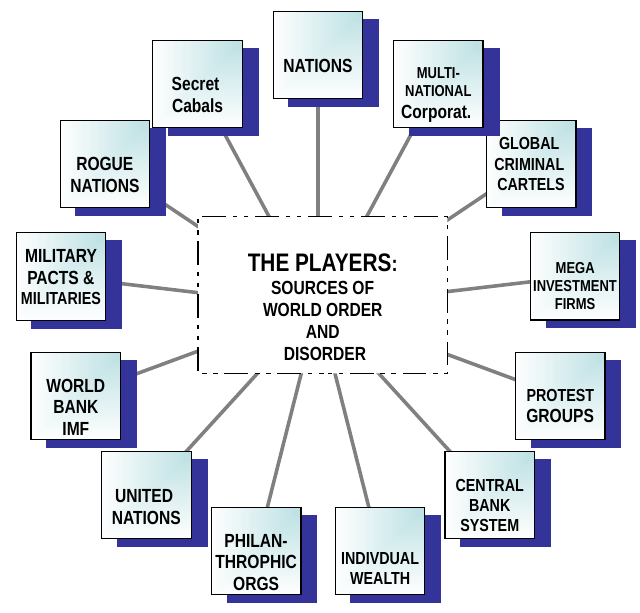
The myth of “nation” determinism is encouraged by a select group of individuals, organizations, and nations who seek to hide their wealth, power, position, and privilege in shaping the world order and disorder. It is to their advantage to function as shadow forces, often beneath the mantle of nations. Their immediate visibility may be hidden, but their influence is profound. The players are displayed in Figure 1.
Figure 1: WORLD ORDER AND DISORDER
Global-Power Matrix
The question must be asked: Can any nation or groups of nations control and dominate the many powerful agencies, organizations, and rogue nations immune or resistant to a nation’s power? Have the times, which nurtured and now sustain, a new array of powers capable of cooperation or contention according to their interests, created a chaotic and desperate dance unresponsive to policies and strategies of control and domination once accepted as successful? A partially visible system now exists, dedicated to the preservation of powerful military-industrial-congressional complex, cited by President Eisenhower in his farewell address (January 17, 1961), as an emerging danger to our nation.
It is assumed nations will pursue the interests of their citizens and state. This too is a myth! What is accurate is certain powerful or rogue nations with access to unlimited military have the capacity to intervene at will to shape the world order through (1) imposed regime changes, (2) invasion and occupation, (3) war, death, destruction, (4) economic and financial controls, (5) sanctions, (6) cultural and religious systems, and (7) many other illegal and immoral policies and actions. Using secretive policies, strategies, and tactics, nations can become shills for private interests. But this Orwellian dystopian situation, relying heavily on military power and private wealth, is now leading the world toward disaster.
In today’s global community, many competing nations, and their hidden shadow groups, have access to military power and might. They also have access to other means of exercising power including economic, historic, moral, religious, and information communication technology (ICT). For the latter, the word and process becomes both a shield and weapon.
I must include “protest groups and factions” because they are present, and exercise some direct and indirect influence. Indeed, responses to these groups and factions (e.g., unions, abolish nuclear groups, Wall-Street protestors, environment activists, peace advocates) often require even more assertions of power and might by those in power. In this respect, the groups and factions are players, albeit often desperate amid their limited numbers and organizational stature.
The World Order: “Games” and “Gambles”
The seductive “games” and “gambles” to control and shape world order has been played for thousands of years by individuals, societies, and “nations.” The prize for winners: Empire! Global domination, control, and wealth! Why? With domination and control comes power to impose selfish interests on conquered people, regions, and societies. A certain “cache” is also sought! Etching the names of individuals, groups, and nations, amid the famous and infamous collection of empire, suggests “immortality.” We may despise those enshrined in history, but we cannot deny they remain alive in memory — now omnipresent in Google.
Even a passing knowledge of world history reveals the pursuit of “empire” has ancient roots (e.g., Egypt, Greece, Rome, China, Aztec, Inca, Ottoman, Mayan). The words of the romantic-era poet, Percy Bysshe Shelly’s (1792-1822), Ozymandias, capture the inevitable demise of empire. But while it lasts, it is an intoxicating and blinding stimulant, feeding heart and mind with the pleasures of adulation and comforts of power:
Ozymandias
I met a traveler from a distant land, who said:
“Two vast and trunkless legs of stone
Stand in the desert . . .
Near them, on the sand,
Half-sunk, a shattered visage lies . . .
And on the pedestal these word appear:
“My name is Ozymandias, king of kings: Look on my works ye mighty, and despair!”
Nothing beside remains
Round the decay of that colossal wreck,
Boundless and bare,
The lone and level sands stretch far away.”
The Pursuit of Empire
The pursuit of empire continues! Ozymandias embody the tragic impulse and result. Power, its inevitable rise and fall! No lessons learned! Only the deceptive rush of visions immune to reason! Empire remains the quest for nations and their private supporters seeking protection and opportunity. Empire is no longer confined to a sovereign state or nation. There are too many competing players. Most are unwilling to yield to a single supreme authority, but eager to use its mantle to pursue their interests.
As Figure 1 displays, the players in the “games” and “gambles” for world order and disorder, sow and protect their seeds. How can a sovereign nation control diverse powers having no loyalty to nation, but loyalty only to their own existence and security? Amid their privacy, they too often escape condemnation, but they too must know “empire” passes. Privatization, the preferred policy of the neo-liberal and neo-con establishments, provides an omnipresent petard on which to fall.
Conspiracy? Of Course . . .
Is conspiracy present? Yes! Conspiracy is an attempt to hide, conceal, veil, or secrete actual events and forces from recognition. Conspiracies exist to serve special interests, contrary to interests and welfare of others. Conspiracies use an array of methods and tactics to elude attention, lest the methods and tactics be recognized as immoral, illegal, and dishonest or criminal. Recall, the villainous lies, deceit, and abuses used by the Bush-Cheney government to invade Iraq, and cast the Middle-East into flames: Iraq has nuclear weapons; we must use torture to obtain information; a global war on terrorism is necessary. With their actions, they indicted our nation, embedding us in endless war. Citizens became co-conspirators by our passive agreement (See Abby Martin interview with Lt. Colonel Wilkerson, former assistant to General Colin Powell, who was tricked into claiming Iraq had nuclear weapons (see http://fktv.is/the-classic-decay-of empires-us-army-colonel-lawrence-wilkerson-27480). Wilkerson points out the massive deceit used by a small group with access to power to launch the USA into a “total” global war.
The ubiquitous iconic “back room” of politics is not a myth! It exists and functions to maintain public ignorance, under the guise the public does not need to know, for it would not understand what we must do. The conspirators: En loco parentis! We act for your welfare by protecting our welfare. “Trust us! Trust us! If you do not, do not stand in our way!”
What tragedy! What a betrayal! What a despicable effort. This effort continues across the spectrum of “players” involved in the “games” and “gambles” of world order and disorder! The players have the political, economic, and military power to continue the “games” and “gambles.” They lack only moral justification. A tangled web of deceit!
Table 1 offers a list of policies and actions used by the world order players. It is frightening! These are not limited to nations or governments. They have become part of the options available to private individuals, groups, and commercial organizations. This is what is so frightening and dangerous! The foe and their methods escape visibility and prosecution. The justice systems normally relied upon to keep order and to protect, are part of the problem. There is an unbounded flow of mutual connections across the nations and groups via common board members, financial supporters, and shared visions of morality.
Table 1: Policies, Actions, and Alternatives (Alphabetized)
In Support of Nation and Other Organization Aims and Goals
Assassinations/death squads/drones;
Bounties for info/capture, and assassination;
Bribery, purchase, and installation of pro-American leaders and dictators;
Celebration of national “morality” in the face of evil acts;
Collaboration/contracts with foreign universities, scientists, professional organizations, and intelligence agencies defaming their character;
Contingent “humanitarian” aid – implicit and explicit;
Contingent “foreign” aid;
Control of UN via vetoes and economic and political pressures;
Control of IMF and World Bank;
Cooperation with foreign nation security services (e.g., military, intelligence, corporations);
Development of domestic crowd controls (militarization of police);
Drones(Widespread use of drones by domestic/national groups and agencies);
Drug wars. Corruption of local officials;
Disproportionate support of “allies.” Enemification of others;
Entrapments of targeted individuals and groups – persons of interest;
Establishment of military bases [more than 700 known USA foreign bases];
Exportation of unpopular American culture (i.e., consumerism, materialism, commodification, competition, crony capitalism, corruption, celebritization)
False flag operations disguised military and/or economic interventions/invasions);
Foreign student/faculty/consultant exchanges (used for intelligence recruitment);
Fund development of disguised/pseudo-organizations used for national military and security purposes (e.g. Human Ecology Fund, ONR, AID);
Glorification of war, militarism, warrior mentalities and images, machismo;
Hegemonic globalization (i.e., control of socio-technical changes and economy);
Infiltration of peace, anti-war groups, and social activist organizations;
Invasion and overthrow, including regime change;
Justification of torture (“enhanced interrogation”);
Mass surveillance, monitoring, and archiving of info/communication data;
Massive growth in government/private intelligence agencies and organizations;
Media influence and control via biased news and biased news commentators;
Military interventions and occupation of nations and regions;
Mind control technologies (e.g., drugs, EMR, behavior control technologies);
Negotiation/conflict resolution delays are now policy;
No Prosecution of connected military, government, civilian law violators/abusers;
Military occupation of foreign nations, regions, and cities;
Promotion of nationalism, pseudo-patriotism, USA exceptionalism;
Project for a New American Century (Developed to insure USA Hegemony);
Project Infra Guard (Collaboration between FBI and hundreds of thousands of businesses in USA to report on citizens resulting in creation of mass list of citizens with no opportunity for contesting surveillance. (Every mall and every store provides video and other personal information;
Propaganda to instill citizen fear, and vilification of individuals and groups;
Recruitment of spies, informers, collaborators, agents among friends, neighbors. The best spy is a person who doesn’t now they are a spy, but in fact, as they share information on neighbors, friends, and family, the information is collected and archived;
Renditions in numerous countries;
Use surrogate nations and forces to accomplish military goals;
Use false-flag incidents;
Use major philanthropic foundations to influence policy and actions;
Vilification, demonization, enemification of domestic and/or international critics;
Weapons/arms dealer sales for money, and for promoting conflicts;
Witness protection programs.
What an array of possibilities! In a world of lawlessness, anything goes, and does! We remain in shock at the destructive events occurring across the world. Yet we too often ignore these events as consequences of the protected policies and actions of nations, individuals, private organizations, engaged in protecting their interests. Millions of lives and life are lost oblivious to the sorrow and grief exacted. Protected from harm, the perpetrators of harm are engaged in the “games” and “gambles” of world order and disorder. To what end?
He is known nationally and internationally as a pioneer figure in the study of culture and psychopathology who challenged the ethnocentrism and racial biases of many assumptions, theories, and practices in psychology and psychiatry.
In more recent years, he has been writing and lecturing on peace and social justice. He has published 15 edited books, and more than 250 articles, chapters, book reviews, and popular pieces.
[themify_quote]Coda: It is WRONG — morally, ethically, legally — for any nation or people to pursue political, economic, and/or cultural interests, security and safety by openly or insidiously imposing upon any other nation or people, a form of political, economic,culture(e.g., values, religion, language), and/or military invasion, occupation, and control that serves to colonize, oppress, and/or dominate this nation or people by any other means limiting self determination.[/themify_quote]
These are my words; but THEY are not words of my making. These words, and the thoughts they embody, appear in timeless historical documents inspired by anti-war and anti-violence advocates.
TOTAL WAR
The United States of America (USA) is engaged in Total War!” “Total War” is not restricted to the USA. It is an old strategy designed to defeat a targeted population through the use of “any and all means.” The USA has used “total war” to not only defeat and subdue a targeted population or nation, but to destroy, annihilate, and humiliate a targeted foe’s historical traditions, languages, values, and potential for survival capable of resisting destruction.
“Total War” is a military-like strategy designed to win a war by engaging in assaults on “any and all” of a nation’s resources as legitimate military targets. This includes domination and control of media, entertainment, financial systems, and purchased leaders.
Exportation of USA Popular Culture
For the United States of America, “Total War” involves the direct and indirect exportation of USA popular culture, resulting in the “weaponization” of culture manifestations, representations, and expressions. Exportation becomes a powerful way for invasion, occupation, dominance, and ascendancy of organizations, societies, and nations. Among the notable consequences “total war” via the exportation of USA popular culture are:
Colonization of minds in accord with USA values, knowledge content, and ways-of-knowing (i.e., epistemology), ways-of-being (i.e., ontology), and ways of acting (i.e., praxiology);
Homogenization of human behavior supporting global uniformity and conformity while destroying variation, diversity, and differences;
Promotion of major USA goals (e.g., hegemonic globalization, unregulated capitalism, corporate domination of local and national policies, dollar supremacy, and USA ascendancy as the sole world power (e.g., Project for a New American Century);
Formation of military alliances, distancing the USA from possible threats from other nations. There is increased dependency upon USA military protection, and sales of military arms to conquered people and nations;
Presence of military bases to secure USA dominance and stability. (There are now an estimated 1600 USA military bases around the world. USA Africa Command has established 35 military bases).
From the point of view of costs and military invasion, exportation of USA popular culture is an effective way to win! “Acculturation” becomes palatable when communicated as “modernization,” “progress,” and “change.” It is “change,” but it is neither “modernization” nor “progress!”
Once USA popular culture is implanted in other nations, “Regime Change,” with the assistance of financial corruption and military control, becomes a predictable course. With bought pro-USA leaders, the USA controls a nation’s future. Indigenous cultures often disappear, population declines, local life forms become extinct, and natural resources become exploited. The “gift” of USA popular culture is often incompatible with human survival because it is based on exploitation.
USA residents sense they are captive to their own culture, yet appear unable to liberate themselves from the matrix of powerful events and forces. Amid pauses and respites from the comforts of pizza, wings, beer, shopping, TV football games, “unreality” shows, biased media, computer games, and omnipresent advertising, they sense something is wrong, but they feel powerless to escape. Agency is lost! Habits are difficult to break! Go along! How long can it continue?
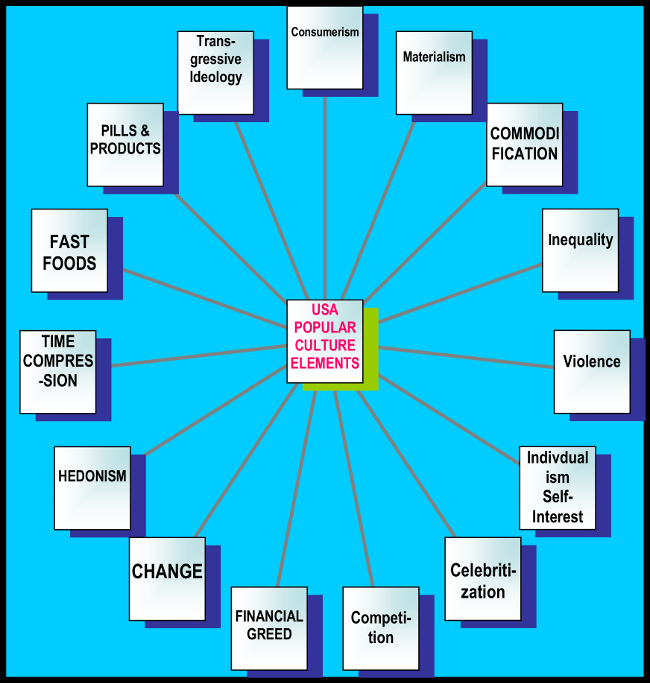
Elements of USA Popular Culture:
Consumerism:The promotion of the constant and unlimited purchase of goods as a source of personal satisfaction and status. Consumerism has little concern for the consumption and exploitation of natural and human resources. (Sustainability)
Materialism: The belief that personal worth and well being is directly related to the acquisition of tangible goods and personal possessions. Materialism is a major source of consumerism. (Spirituality)
Commodification:The assignment of a monetary value to all things so they can be treated as commodities (i.e., articles of commerce or trade on the commodity market and exchange) to be considered in determining worth and value. Within this ethos, money becomes a critical arbiter of personal, governmental, and commercial decisions. (Human Worth)
Inequality/Privilege/Diversity:This American cultural ethos seeks to hide or disguise itself amidst spin, platitudes, and self-righteous assertions in government, commerce, media, and religion, but the harsh reality is that the very diversities we claim to support constitute sources of their absence or minimal existences. Racial, ethno-cultural, gender, sexual preferences, social class, and a host of other biases define popular culture, and are sustained by it. (Diversity/Equality)
Violence and Power: The impulse and tendency to use harsh and abusive force for both pleasure (e.g., football, computer games), and to pursue power (e.g., bullying, gangs, war). There is a tolerance of violence and, in many ways, a fascination with its expression and consequences. (Peace/Justice)
Individual Self Interest: A focus on the “individual” to such an extent that there is minimal attention to the consequences of this for the social and collective nexus. Support for individual rights, while essential for the protection of human freedom and liberty, is often in conflict with the needs of a society and nations (Social Interest,Gemeinschaftesgefuhl).
Celebrity Identification and Pre-Occupation:The attachment and concern for the lives of celebrities to such an extent that there is preoccupation with the events in celebrity lives at the expense of concern for critical issues in one’s own life and events of the wider world (e.g., People Magazine, TV shows, fan clubs, social networks). (Attachment to “Ordinary” Citizens and Neighborhood Life)
8.Competition:Competition is a defining trait of the American national character and daily life. Throughout education, commerce, entertainment, athletics, and political arenas of life, competition is considered good and to be encouraged. “Survival of the fittest” is an ingrained virtue, and there is often little concern or admiration for those who are second best. (Cooperation)
Financial Greed:In accord with its capitalistic system and attachment to competition in all areas of life, the unbridled pursuit of profit has turned into greed—an excessive desire to acquire money and material wealth often at the sacrifice of all ethical, moral, and often, legal standards. (Sharing)
Rapid and Constant Change:The emphasis on rapid “change” and the pursuit of the new is a valued goal and activity. This is powered by the new technology. This emphasis continually pushes the boundaries of current and conventional beliefs and activities to new limits. This is especially true for TV programs, movies, computer games regarding explicit sexuality, violence, and dress styles and fads. (Tradition, Continuity)
Hedonism:While the pursuit of pleasure is certainly a “normal” human value and behavior, first articulated in great detail in ancient Greece, and subsequently in Western psychology (behavior is motivated to seek pleasure and to avoid pain), its pursuit in America is unhampered by the extensive freedoms to self-indulge, and to disregard tradition or convention. These views often conflict with religious beliefs that see seeking pleasure as a sin. (Self-Denial, Endure, Restraint)
Time Compression and Management: The response to time as a commodity tom be negotiated via multi-tasking, cost-benefit tradeoffs, immediacy rewards, quotas, computer speeds, and highly scheduled family and children’s lives pervasive throughout USA culture. Other cultures share this obsession, but it seems to me, the USA is the major advocate of time compression and management (Aside from sweatshop slave labor in various Asian countries caught in production quotas). (Enriched Time; Fulfilling Time)
Fast Foods: Elements of “fast food” include brief, immediate, or non-existent eating breaks, inexpensive food, high-caloric energy foods, salt and sugar taste-disguises, and poor nutrition value. Fast food is not unique to popular USA culture. However, USA Fast-Food Industries have refined the contents, production process, distribution, and taste to mass population appeal. It is hard to resist bacon, hamburgers, fries, fried chicken, wings, hot dogs, pizza, tacos, and sweetened carbonated beverages (Nutrition; Weight Management; Time Stress Management).
Transgressive Ideology: An emerging cultural ideology that accepts as normative, violations of human decency and morality by promoting illicit behaviors (e.g., violent murder, torture, rape, pedophilia, incest, pornography, substance abuse, sado-masochism) involving all ages. This is manifesting itself in literature, movies, music, and television. (Civility, Decency, Respect)
Pills, Products: While all cultures produce and use pills and products to treat illness and to promote health, wellbeing, and appearance, the USA supports massive national and international industries (e.g., cosmetic, pharmacological) in these areas. In combination with effective and seductive advertising, homes in the USA are filled with pills, lotions, potions, salves, and devices. (Natural Substances, Holistic Medicine).
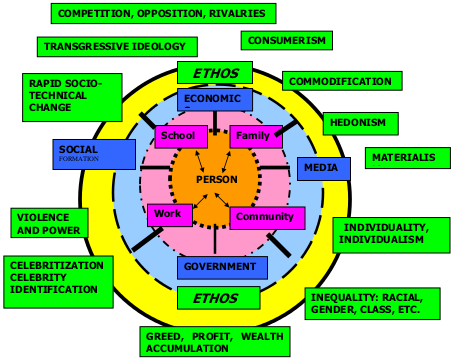
These elements are displayed graphically in Chart 1. Each element of USA popular culture carries with it an explicit and implicit socialization power transcending invasion, occupation, dominance, and ascendancy. It is a colonization of mind, designed to erase and denigrate past.
As the cultures before the invasion of USA popular culture, disorders and deviancy emerge including alcoholism, prostitution, crime, family disintegration. Logo t-shirts emerge and become carriers of a new culture. It is called, “identity with the aggressor.”
Some Closing Thoughts
There are other symbolic, verbal, and material representations of USA popular culture including (1) USA exceptionalism; (2) “I did it my way mentality,” and (3) sexualization of advertising. My point is made. Think about it! Each day we are caught in a cultural web we openly criticize, and yet we cannot seem to escape. Constant advertising keeps us confined to the advertising messages.
The power of USA popular culture is vast and complex. It has been exported to virtually all nations. It is a “war-like” invasion and occupation of a way-of-life, displacing and overwhelming existing cultural values and practices. Even as the USA is subject to increasing criticism for its abusive and intrusive actions in the culture’s of other nations, USA leaders appear reluctant to accept criticism. Like it or not, we won!”
CHART 1: ELEMENTS OF USA POPULAR CULTURE
Footnote (1):
This article is part of a continuing series of publications I have authored on critiques and commentaries of USA foreign relations strategies, policies, and tactics. I have contended USA is engaged in immoral, unethical, and illegal actions, including war, invasion, occupation, and exploitation of foreign nations and people toward the promotion of USA global dominance, control, and supremacy. Examples of relevant articles follow:
2011…Anthony J. Marsella The United States of America: A culture of war. International Journal of Intercultural Relations, 35, 714-728.
He is known nationally and internationally as a pioneer figure in the study of culture and psychopathology who challenged the ethnocentrism and racial biases of many assumptions, theories, and practices in psychology and psychiatry.
In more recent years, he has been writing and lecturing on peace and social justice. He has published 15 edited books, and more than 250 articles, chapters, book reviews, and popular pieces.
Marsella, A.J. (2011), The Journal of Oriental Studies, 21, 148-163
Abstract
“Fission” and “fusion” are the most basic principles used to explain the creation and evolution of our universe. From that moment—13.7 billion years ago—when all existing matter, particles, and energy exploded across time and space, “fission” and “fusion” have remained our keys for understanding cosmic creation and the endless transformations of our cosmos. “Fission” is the process of “separation,” of division; in contrast, “fusion” is the process of “uniting, of integration. Whether we behold the heavens above, or the world about us, the processes of “fission” and “fusion” are omnipresent. Yet, too often, we have failed to grasp the reality of “fission” and “fusion,” and to recognize that they are present and relevant in all we are, in all we do, and in all we can become. This is especially true for that critical part of our lives in which we seek to understand our meaning, purpose, and identity through the pursuit of peace.
Peace is that state of conscious existence in which we find serenity, harmony, and unity with all about us, including the cosmos itself. We seek peace in an effort release us from the burdens of uncertainty and conflict found in life. Yet, too often, as we pursue peace via “inner” and “outer” journeys, an important insight is missed. As we pursue peace, whether through meditation or through service to others, our journeys are often kept separate from one another. In keeping our journeys separate, we may find comfort, but never true fulfillment, for this can only occur when the oneness or “unity” of our nature is experienced. “Unity” is rooted within the principles of “fission” and “fusion.” Although our ego can deceive us into concluding that things exist separately, this is not the nature of the cosmos. Pursuing peace through a separation of our inner and outer natures will always result in a felt sense that something is missing.
For our cosmic nature to be fulfilled, our inner and outer natures must be must not be detached from each other. The union of our natures is in accord with the cosmic principles of “fission” and “fusion” in which all things exists in relation to others, and all things find their actualization through the cosmic ecology in which reciprocity and symbiosis are necessary. This is in accord with the mystic law of Buddhism. The principles of “fission” and “fusion”—of separation and integration — have guided, shaped, and informed our views of the universe and of human nature. Before these principles we must respond with awe, reverence, and humility for they reveal that we are the stuff of stars, and that our inner and outer journeys in pursuit of peace will find their full realization in their unity.
Introduction
It was the best of times, it was the worst of times, it was the age of wisdom, it was the age of foolishness, it was the epoch of belief, it was the epoch of incredulity, it was the season of Light, it was the season of Darkness, it was the spring of hope, it was the winter of despair, we had everything before us, we had nothing before us, we were all going direct to heaven, we were all going direct the other way.
Charles Dickens (1812–1870) A Tale of Two Cities—1859
The centuries-old words by the English author Charles Dickens find currency in our times. All about, we see the wonders of human creation, and the potential of the human spirit. And yet, amidst all of this, we find ourselves bewildered by the contradictions, conflicts, and hypocrisies that abound. We yearn for solutions. We search the heavens and the depths for answers as we witness the collapse of the myths we once lived by. We are faced with great uncertainties, and with few resources beyond our personal creativity to resolve them. Is this where answers reside?
Vaclav Havel (1994), the former poet-president of Czechoslovakia once wondered about the same question. He stated:
For the real question is whether the “brighter future” is really always so distant. What if, on the contrary, it has been there for a long time already, and only our blindness and weakness has prevented us from seeing it around us and within us, and kept us from developing it.
There is something very Buddhist about these words — something that reminds us of the need to release our mind from the fetters of daily life, to free us from the constraints of society, and to experience the truths that exist within, and to use them to change the world beyond.
The Pursuit of Peace
I wish to begin this evening by expressing my deep appreciation and gratitude to Daisaku Ikeda and the staff and members of Soka Gakkai International for offering me this special opportunity to speak on a topic of universal concern and urgency—a topic that has, in many ways, dominated most of my life—the pursuit of peace.
I found myself, even as a young child, bewildered and confused by the apparent absence of any deep sense of contentment or satisfaction among those about me—and certainly among them any deep sense of an abiding happiness or fulfillment. There was simply the need to survive.
Today I find the same to be true. Too many people are caught amidst the crucible of material values, and the subsequent demands for consumption and the acquisition of goods and property that materialism requires. There are scores of frivolous popular distractions to be found in entertainment, sports, music, and celebrities’ lives. But the desperate search for satisfaction, purpose, and fulfillment is just below the surface. People seek a release them from their sense of want and emptiness in these places and experiences only to find that the special state of inner and outer peace they need eludes them.
I also found myself bewildered by the world about me—a world filled with so many obvious problems of human suffering that we all have either experienced or observed—the problems of poverty, racism, violence, and oppression. All of these problems continue in global proportion and are too often ignored or denied by our more immediate human needs to survive and to hope for better day.
I can only wonder now, what, if any, the distractions and opiates of our industrial and technological age have had upon the traditional Japanese psyche—the possible impacts life in a global era have had upon that special inner spirit and unique outer expressions of Japan’s character, mind, and views of human nature. It is perhaps no accident or coincidence that I join you this evening, but rather some evolving of seeds planted long ago—some teleological push and pull—that enables us to gather this evening to explore the mysteries of peace that reside in understanding the connection between the inner and outer nature of our beings.
And so I come this evening eager to share some thoughts on the timeless human concern for peace, a concern that has been pursued throughout history and across every land and people: a concern that has been exemplified in the lives, wisdom, and thoughts of such great Asian leaders of religion and philosophy of our past as Shakyamuni Buddha, Lao Tzu and Confucius of China, Mahatma Gandhi of India, and Josei Toda of Japan; and also leaders of our present such as Aung San Suu Kyi of Burma, Thich Nhat Hanh of Vietnam, the Dalai Lama of Tibet, and Daisaku Ikeda of Japan. These voices, of course, though nurtured within particular cultures, offer thoughts that resonate and resound across the world and across time. You will recall that Buddha (563–483 BCE), more than 2500 years ago, said: “Better than a thousand hollow words, is one word that brings peace.” And Lao Tzu (570–490 BCE), with similar wisdom, noted the endless connection between peace in our individual hearts, and peace in the world when he wrote:
If there is to be peace in the world, There must be peace in the nations. If there is to be peace in the nations, There must be peace in the cities. If there is to be peace in the cities, There must be peace between neighbors. If there is to be peace between neighbors, There must be peace in the home. If there is to be peace in the home, There must be peace in the heart.
Following in the paths of these wise observers of the human condition, Shantideva, the Eight Century Bodhisattva, observed:
“Sentient beings are strange, although wishing happiness they avoid its causes. Although wishing to avoid suffering they constantly create its causes.”
Within the same tradition of thought, and with similar sensitivity, the current Dalai Lama (July 6, 1935—present) stated:
“I believe all suffering is caused by ignorance. People inflict pain on others in the selfish pursuit of their happiness or satisfaction. Yet true happiness comes from a sense of peace and contentment, which in turn must be achieved through the cultivation of altruism, of love and compassion, and elimination of ignorance, selfishness, and greed.”
Among these icons of peace, these teachers to humanity, also stands Daisaku Ikeda, whose tireless voice has for more than a half-century advanced the cause of peace through writings on the essentials of Buddhism, especially Buddhism’s fundamental recognition of the connections between inner and outer journeys for peace. Daisaku Ikeda’s words reflect the larger principle of interaction, reciprocity, and symbiosis that characterize all life. He states:
If I were to propose a way of looking at the world . . . I would single out an “ethos of symbiosis.” I am talking about the kind of mentality that favors harmony over opposition, unity over division, “we” over “I.” Practically, it is expressed as the idea that human beings should live in harmony with other and with nature (Ikeda, 2010, p. 156).
Later in this address President Ikeda notes the fundamental concept in Confucianism of the great unity (datong) of all things, a unity that has had important implications for Confucian codes of social relationships and obligations. The idea of a unity derived and sustained via a reciprocity (i.e., ecology, symbiosis) of the inner and outer elements of our being among all things, is, of course, the defining principle of Mahayana Buddhism, in which “enlightenment” occurs from a dedication to self and to others. Mahayana Buddhism asserts that because of the inseparability of self and other—of our inner and outer nature—we have a special responsibility to serve others. This is an essential part of the pathway to peace. This belief is, as we all know, the way of the Bodhisattva, the person who seeks to help others attain enlightenment through their own compassion, empathy, and personal sacrifice. I am fond of the words of the great Bodhi, Shantideva, whose endless verses expressing his desire to serve others reflect his integrative nature.
By the virtue amassed by all that I have done, May the pain of every being be completely healed. May I be doctor and medicine, and may I be nurse, For all sick beings in the world, till all are well. May food and drink rain down to stop all thirst and hunger. And during times of famine, may I turn myself into food and drink. May I be an endless treasure for the poor and destitute; May I turn into all things they could ever need, And may these then be placed close beside them. With no sense of loss, may I give up my possessions, even my body, And all past, present, and future virtues, to help all beings.
Quoted in Thurman, R. (1998). Inner Revolution: Life, Liberty, and the Pursuit of Real Happiness. NY: Riverhead Books, pp. 158–159.
Robert Thurman, a Buddhist scholar who studied Tibetan Buddhism, and is currently at Columbia University in New York, writes: “This is the messianic drive of the Bodhisattva, the spirit of love and compassion called the enlightening soul. It is not merely the wish that all be well with all beings—it is the determination that you yourself will assume responsibility for others (Thurman, 1998, p, 159).”
Of course, in helping others, the Bodhisattva actually helps him or herself via the emerging awareness and consciousness of the cosmic law (sometimes called mystic law) of unity and oneness that is termed Myoho-renge. Daisaku Ikeda (2011), has noted that idea of “integration” is expressed in the Buddhist term “kechi-en” (literally, to “join” a “connection,” it denotes a causal relationship or function that joins life and its environment). “Kechi-en” is associated with the theory of “dependent origination,” an important belief advanced by Buddha and his followers. Dependent origination holds that every phenomena, be it social or natural, is the result of connection with something else.
Nothing can exist in total isolation; everything is interrelated. Daisaku Ikeda points out that the Buddhist idea of inter-relations is multidimensional and it goes beyond the immediacy of the moment to space and time. Before the magnificence of these words, and before the thoughts of such great figures of peace, I must say that I am humbled by the task before me. I am hopeful that in our brief time together, I will, in some way, offer you thoughts that will add to your own insights about the nature of peace—insights that have been forged from your personal experiences and efforts to pursue peace amidst our challenging times.
Above all, know this, I come to you this evening to re-affirm the thoughts of those who have come before us, who have recognized and spoken of the intimate connection between inner and outer peace—between the inherent connection of all things, between our human pursuit for meaning, purpose, and fulfillment, and the unfolding of the moment of cosmic creation.
The Pursuit of Peace: The Inner and Outer Journey
Permit me, if I may, to intentionally disturb any comfort you may be having with your life, by sharing some thoughts on the complexities and inconveniences of pursuing peace. I will, for a few moments, play the “clouds,” as articulated so wondrously in the great Haiku master, Matsuo Basho’s (1644–1694) eloquent poem about attending to the necessary disturbances in our life. Basho writes:
“Clouds come, from time to time, to give man a rest from looking at the moon.”
Inner Peace
The task before all of us is to grasp the essential principle of life – of “embeddedness”—of the constant cosmic process of “fission” of “fusion” that separates and joins all things. While our human brain leads us naturally to separate and detach all things about us and to assign them names and symbols for easy identification and retrieval, it is an illusion that all things are separate, isolated, and detached. The physical reality is that all things are connected and flow endlessly into one another.
You will recall here the Japanese term “Engi.” Daisaku Ikeda (2010) offers a powerful understanding of the term:
The Buddhist principle of dependent origination (Jpn. Engi) reflects a cosmology in which all human and natural phenomenacome into existence within a matrix of inter-relatedness. Thus we are urged to respect the uniqueness of each existence, which supports and nourishes all within the larger, living whole. What distinguishes the Buddhist view of interdependence is that it is based on a direct, intuitive apprehension of the cosmic life immanent in all phenomena. Therefore, Buddhism unequivocally rejects all forms of violence as an assault on the harmony that underlies and binds the web of being. (Ikeda, 2010, pp 235–236—in A New Humanism).
Marsella (1995, 1999) offered similar comments in advocating guidelines for living a spiritual life. In his first guideline, he stated:
I resolve to be more aware and responsive to the spiritual dimensions of my being and my nature. I intend to accept and to embrace the self-evident truth that the very life force that is within me is the same life force that moves, propels, and governs the universe itself, and because of this, I must approach life with a new sense of awe, humbled by the mystery of this truth, yet elated and confident by its consequences. I am alive! I am part of life! And, because of this, I must act in ways that encourage and support this fact, and I must act in ways that are responsive to its requirements and demands. . . . I resolve to perfect the spiritual dimension of my being because it is in this pursuit that I can discover and fulfill my unique destiny in the larger cosmic plan whose details remain unknown, but whose intent seems clear—the promotion of an evolutionary harmony, balance, and synergy among all life forms. (Marsella, 1994, p. 10, 1999)
It is a fundamental principle of nature—and especially of life itself— that if we continue to separate ourselves from the larger natural and social world in which we exist, we cannot become all that we are capable of becoming as an expression of life. We must, as so many great thinkers in philosophy and religion have stated, recognize our connections to the broader order, and become part of it.
All of us are aware of the current human condition. We find ourselves beset by overwhelming problems of mind and person that bring us distress and discomfort. We seek peace. We desire that wonderful sense of harmony and being centered in life. We desire the calmness, tranquility, and serenity that is the heart of peace. We desire that sense of unity with all about us and with the very cosmos itself. But all this eludes us. We try, often desperately, to experience peace, but too often experience fear, anxiety, distrust, anger, frustration, despair, uncertainty, and alienation. We turn to those things that we are told will bring us “inner” peace, including reflection, contemplation, prayer, meditation, chanting, yoga, therapy, and even substances such as tranquilizers, alcohol, and illegal drugs. We consider going on a retreat from the world and entering a distant monastery that will isolate us from the world. We turn often to religions, hoping to find within their beliefs and practices the peace we seek.
In discussing asceticism, Chumley (2011) points out that there is much virtue in pursuing inner peace through a life of asceticism or withdrawal and contemplation. But he also notes that withdrawal is not as important as the effort after tranquility that comes with being silent and still. He writes:
Does it take leaving the world behind to become spiritually enlightened? Does one need rigorous asceticism to encounter God? It may be argued that many of us already lead solitary lives in our own modern equivalent of caves and monasteries: the cells of modern apartment buildings found in impersonal high rise buildings and desert caverns of urban avenues. While there has been an exodus away from churches and “organized religions” in recent decades, record numbers of spiritual seekers are meditating and praying on their own, in new churches, on yoga retreats or in nondenominational meditation centers. There is much value in simply taking time to be silent and still. There is tremendous power in setting oneself aside and letting the likeness of God inside you shine through. Settling down and quieting the frenetic stimuli of modern multitasking not only brings peace and calm, it may also be a revelatory experience (something the ancients expected and called “epiphanic”) (Chumley, 2011).
And yet, by itself, in my opinion, the inner journey for peace alone will always be insufficient, for it keeps us focused on our internal mind. We may find temporary comfort. But, ultimately, there will be a sense of being incomplete, for the virtue of pursuing and joining inner and outer will not be present. The joining is what characterized Buddha’s life! The “inner” journey is not unimportant. Rather, its fullest and most complete virtue may be in making us aware that connection and unity require service to the world beyond ourselves.
Retreat from the problems of our world is unacceptable. Rather we must address the inequities and injustices with a felt sense of passion that comes from meeting our social responsibilities, obligations, and duties – our outer journey. I feel the pursuit of the “inner” journey by itself denies the fundamental principle of life itself that we are both separate (i.e., self-assertive) and connected (integrative). An active and intentional melding of inner and outer peace efforts is the most direct and obvious expression of life.
Outer Peace
Friends, ladies and gentlemen, young and old, rich and poor, we are beset by a world that challenges the very nature of our being. I have written previously:
Human survival and well being is now embedded in a complex and interdependent global web of economic, political, social, technical, and environmental events, forces, and changes. The scale, complexity, and consequences of these events, forces, and changes constitute an important challenge to our individual and collective well being by confronting us with an array of complex, conflicting, and confusing demands and/or opportunities. Our response to this challenge— as individuals, societies and nations—will shape the nature, quality, meaning, and [security] of our lives in the coming century(Marsella, 1998, p. 289).
We gather in a time of political, cultural, economic, and moral upheaval for our world. We are faced with more than 35 wars, insurrections, and peaceful revolutions of various proportions. We are faced with endemic global poverty, widespread environmental abuse and collapse, vast waves of transnational migration, numerous epidemics of deadly diseases, growing numbers of political and economic refugees, global population growth that is disproportionate for our resources and cultural life styles.
We are being overwhelmed by an information and communication technology that threatens—by its very power and popularity—to reshape the human mind and our views of human nature itself. Our lives are increasingly controlled by a world of multinational corporations who urge us through constant marketing and advertising to be what THEY wish us to be—consumers and materialists—telling us that only through business and commerce can our security be assured. We seek comfort and hope from all those societal institutions—government, business, education, religion—that we expected would offer answers and protection, only to find that they have become part of the problem, part of the challenges to our needs for security and safety.
We are faced with the forces of globalization, regionalism, nationalism, and localisms—each competing for our loyalty, approval, tolerance, and identity. They seek control of our lives. These forces seduce us, even as we try to resist them. Like the sirens of Homer’s ancient Greek novel, The Odyssey, we turn from them again and again, recognizing their dangers; we try to resist them, yet we know that they will return again and again until we yield. Amidst this milieu, we find ourselves bewildered, much as I was in my youth.
I could see the discontent, I could see the suffering, I could see unhappiness, I could see the anger and frustration, but I could not understand why it continued and why so little was done to ameliorate it. We continued—often unaware of the very lives we were leading, of the discomforts, of the punishing consequences. We endured—seeking, hoping, wondering—if at some point, an answer would come from someone, from somewhere, at sometime.
Arthur Koestler— The Ghost in the Machine
I needed an idea—a liberating thought that would help coalesce and crystallize my thinking. I found that from a novelist turned social commentator, Arthur Koestler, in his 1967 book with the unlikely title“ The Ghost in the Machine, a volume by a non-psychologist about the poverty of psychological thought and theory as it remained mired in behaviorism and other mechanistic views of behavior.
Koestler advanced the concept of a “holon,” in which he observed that all things are part of something larger, even as they seem to exist separately. He termed his idea the “Janus Principle,” named after the Roman god who faced two ways. In a wonderful example that has remained with me through the years, and continues to guide my thinking even here this evening, Koestler noted that we can take a liver cell, place it in a Petrie dish, add nourishment, and it will continue to live for ages. But, it will never know or realize its true nature; it will never be a liver, until it is joined with other liver cells. It is only at that point that its full nature may be experienced. In other words, it is only when it leaves its self-assertive and separate life existence that it can help create something much more that the sum of its parts—a liver—an emergent life form that is more than the simple addition of its parts.
For me, the brilliance of Koestler’s insights—rooted as they were in the earlier general systems theories of Ludwig von Bertalanffy—was the explicit idea that all forms of life, from the cellular to the world itself, consist both of separate elements guided by a “self assertion” principle, and of an emergent element, guided by an integrative principle. My head swirled with excitement! Here at last was different model for human behavior that acknowledged the “embeddedness” of all things in each other—the unity and oneness of life.
Now with greater clarity, I could see that the often pathological and destructive effects of our culture and the nature of our social order and formation. These forces interfered with the natural fulfillment of our human nature. We were compelled to value individuality and separateness. We were prevented by the very culture in which we lived to choose priorities that detracted rather than promoted unity. Life styles—driven, by beliefs, values, and actions that denied the opportunity for connecting to others in pursuit of peace— were a source of problems.
The Cultural and Societal Barriers to Peace
I have identified the following eleven popular culture and societal themes that prevent us from grasping the inner and outer nature of our beings, and keep us isolated in our ego and self-absorption. Indeed, they are among the greatest impediments to the pursuit of outer peace because they emphasize goals and means that have little sensitivity, awareness, or responsibility to the larger social order. I have placed their opposite, or competing tension, in parentheses at the end of each theme.
Consumerism: The promotion of the constant and unlimited purchase of goods as a source of personal satisfaction and status. Consumerism has little concern for the consumption and exploitation of natural and human resources. (Sustainability)
Materialism: The belief that personal worth and well being is directly related to the acquisition of tangible goods and personal possessions. Materialism is a major source of consumerism. (Spirituality)
Commodification: The assignment of a monetary value to all things so they can be treated as commodities (i.e., articles of commerce or trade on the commodity market and exchange) to be considered in determining worth and value. Within this ethos, money becomes a critical arbiter of personal, governmental, and commercial decisions. (Human Worth)
Violence and Power: The impulse and tendency to use harsh and abusive force for both pleasure (e.g., football, computer games) and to achieve preferences (e.g., bullying, gangs, war). There is a tolerance of violence and, in many ways, a fascination with its expression and consequences. (Peace)
Individual Self Interest: A focus on the individual to such an extent that there is minimal attention to the consequences of this for the social nexus. Support for individual rights, while essential for the protection of human freedom and liberty, is often in conflict with the larger social nexus. (Social Interest, Gemeinschaftesgefuhl)
Celebrity Identification and Pre-Occupation: The attachment and concern for the lives of celebrities to such an extent that there is preoccupation with the events in celebrity lives at the expense of concern for critical issues in one’s own life and events of the wider world (e.g., People Magazine, TV shows, fan clubs, social networks). (Attachment to “Ordinary” Life)
Competition: Competition is a defining trait of the American national character and daily life. Throughout education, commerce, entertainment, athletics, and political arenas of life, competition is considered good and to be encour aged. “Survival of the fittest” is an ingrained virtue, and there is often little concern or admiration for those who are second best. (Cooperation)
Financial Greed: In accord with its capitalistic system and attachment to competition in all areas of life, the unbridled pursuit of profit has turned into greed—an excessive desire to acquire money and material wealth often at the sacrifice of all ethical, moral, and often, legal standards. (Sharing)
Rapid and Constant Change: The emphasis on rapid “change” and the pursuit of the new is a valued goal and activity. This is powered by the new technology. This emphasis continually pushes the boundaries of current and conventional beliefs and activities to new limits. This is especially true for TV programs, movies, computer games regarding explicit sexuality, violence, and dress styles and fads. (Tradition, Continuity)
Hedonism: While the pursuit of pleasure is certainly a “normal” human value and behavior, first articulated in great detail in ancient Greece, and subsequently in Western psychology (behavior is motivated to seek pleasure and to avoid pain), its pursuit in America is unhampered by the extensive freedoms to self-indulge, and to disregard tradition or convention. These views often conflict with religious beliefs that see seeking pleasure as a sin. (Self-Denial, Endure)
Transgressive Ideology: An emerging cultural ideology that accepts as normative, violations of human decency and morality by promoting illicit behaviors (e.g., violent murder, torture, rape, pedophilia, incest, pornography, substance abuse, sado-masochism) involving all ages. This is manifesting itself in literature, movies, music, and television. (Civility, Decency, Respect)
Here, now, much to my dismay, I call attention to the fact that these are the dominant themes of American popular culture that have served to erode and homogenize traditional cultures around the world, bringing with them conflicts and commitment to a way of life that lacks substance and keeps populations captive to spurious goals and values. You are already aware of this in Japan, but I wish to remind you of it through a clear identification of the basic values, priorities, and preferences that are currently shaping the world. I wish to make it absolutely clear that I consider these values, themes, and ethoses to be a major impediment to outer peace.
The Way of the Bodhisattva
What possibilities, what paths, what choices are available to us? Can we retreat to a distant monastery, there to live an ascetic life in pursuit of the truths that can only come when the realities of our worldly life are denied and forgotten? Can we remain amidst the worldly challenges, deciding consciously to assume the mantle of social responsibilities, obligations, civilities, and duties? Can we become Bodhisattvas? Yes, of course, we can. It is our nature. But to do so, we must counter the events and forces that promote our separation and detachment in our “outer” journey enabling us to join our two journeys’ toward peace.
It is logical to ask, “What can I do?” “How can I to counter these pernicious events and forces.” The answer is that you must choose “voice over silence, action over passivity, and compassion over selfishness.” The culture in which we live has very different goals than your pursuit of peace and meaning. The culture sees you simply as a “consumer,” helping to keep an abusive and greedy system alive through spending and purchasing. The culture sees you as a “nationalist,” willing to accept your nation’s actions—right or wrong, invading, occupying, and/or controlling others for selfish benefits.
Your reply must be clear and unequivocal. You must do what you can, when you can, to resist the demands of popular culture. Ultimately (Saishu-teki ni), we should serve the causes of justice, tolerance, equality, and sustainability through fostering empathy, compassion, and social interest (gemeinschaftesgefuhl) As I see it at this point in time, we can engage the world, by doing the following:
Accept the Buddhist philosophy of cosmic unity or oneness
Accept the cosmic principles of “fission” and “fusion”
Choose peace over violence, conflict, and war
Choose activism over passivity (Letters, donations, voting)
Choose voice over silence (non-violent protests)
Choose service over selfishness (volunteerism)
Choose cooperation over competition
Choose education and learning over ignorance
Choose courage over fear and comfort
Choose justice over injustice
Unite your personal, professional, and civic lives
Support non-killing: “Assert right not to be killed and take responsibility not to kill others” (see Paige, 2002, 2009)
Support the Universal Declaration of Human Rights
Support Nobel Prize Laureate charter on non-violence (Noble Prize Laureates Charter, 2007)
Choose life—choose Lifeism.
Lifeism
This evening I have shared with you some thoughts on the pursuit of peace via the inner and outer journeys we take in life. But, more specifically, I have said that the distinction between the inner and outer journeys is an illusion because of the very essence of the first instant or moment of creation in which matter and energy sped across space, forming the cosmos and bringing unity and oneness via “fission” and “fusion.” This is the essence of our universe—of the billions of stars that form our galaxy, and the billions of galaxies that exist in our cosmos, and here I must point out that astrophysicists now believe there are many universes beyond our own. This should fill us all with wonder, awe, and reverence. It is life affirming. It is in accord with the act of cosmic creation that erases all distinctions between the inner and outer journey for peace. They are one, and they are animated by life (Marsella, 2007, 2008).
We are part of life, the very force that animates the universe and that is present in all things we call living. We are alive—we are part of life! By accepting this premise, and by making it the core of our identity as individuals and groups, we can affirm a truth so obvious and so critical to our sense of well-being that it can be the anchor for our personal, collective, and national identities. We can move beyond the struggles for identity at individual, cultural, and national levels, in favor of the ultimate identity —life and the ecologies that nurture and sustain it. We can pursue a new philosophy, and a new set of beliefs and practices that considers humanity as only one reflection of life. I call this Lifeism.
There are so many terms across the world that embody the essence of lifeism. For example, there is the South African term “Ubuntu,” which means “A quality of humaneness, embodying the supremacy of compassion and the rejection of anger, resentment, and envy.” Ubuntu combines ideas of remorse and apology with forgiveness and is at the heart of the truth and reconciliation movement. And there is also the Sanskrit term, “Ahimsa,” meaning “The quality of humanness implying the absence of “himsa” or violence that allows one to resist injustice without fear on the one hand or hatred on the other.” There is also the Native Hawaiian term, “aloha,” which is difficult to translate, but essentially refers to love and the intent to establish a spiritual connection. And last, of course, there is the term “Satyagraha”, meaning “nonviolence in being and practice”. This is at the heart of Gandhi’s mission of “nonviolence” and the more recent non-killing movement of Professor Glenn Paige. And we must not forget the Japanese word, “engi,” that refers to the unity and connection among all things. To these we can add “Agape,” the Greek term meaning “an unconditional altruistic love for humanity,” that is considered to be at the heart of Christianity . . . when not forgotten (Marsella, 2006).
Lifeism is that transcendent sense of awe, reverence, and connection in which we are moved beyond ourselves and beyond time and place to new levels of consciousness. Spirituality moves us, as individuals and groups, beyond our past to the richness of the immediacy of the moment. And with this comes an experience of attachment and belonging to something much larger than our individual or collectives experiential levels. We are part of life, and that means we have ties to all forms of life on Earth and to the mysteries of the cosmos itself.
Lifeism encourages us to encounter and to reflect upon death, and to understand its inseparable relation to life. As we behold life in all of its forms, as we witness its blossoming and its passing, we become acutely aware of the inevitable cycle of life and death, especially the fact that they are one. To understand and to accept the mystery that life and death are one can only enrich our life, and can only promote a greater sense of responsibility to promote life. This is a new set of beliefs for our times.
This is spiritual foundation for living amidst the trials we face as individuals, societies, and nations. It calls upon us to grasp and accept the realities of our existence as the stuff of stars, and to live according to the principles of life inherent in our creation. Let us embrace the reality that I/we/life and the universe are one!
REFERENCES:
Bertalanffy, L. (1968). General System Theory: Foundations, Development, Applications. NY: Braziller
Chumley, N. (2011). The Value of Asceticisim. http://www.huffingtonpost.com/norris-j-chumley-phd/the-value-of-asceticism-t_b_806700.html Posted: January 17, 2011 08:32 PM
Henderson, H. (1958). An Introduction to Haiku: An Anthology of Poems and Poets from Basho to Shiki. NY: Doubleday/Anchor.
Ikeda, D. (2004). Fighting for Peace: Poems by Daisaku Ikeda. Berkeley, CA: Creative Arts Book Company.
Ikeda, D. (2010). A New Humanism: The University Addresses of Daisaku Ikeda. NY:I.B. Taurus
Koestler, A. (1967). The Ghost in the Machine. NY: Macmillan.
Marsella, A.J. (1994). Making Important New Year Resolutions. Honolulu Star Bulletin, December 30, p. 10.
Marsella, A.J. (1998). Toward a Global Psychology: Meeting the Needs of a Changing World. American Psychologist, 53, 1282–1291.
Marsella, A.J. (1999). In Search of Meaning: Some Thoughts on Belief, Doubt, and Wellbeing. The International Journal of Transpersonal Studies, 18, 41–52.
Marsella, A.J. (2006). Justice in a Global Age: Becoming Counselors to the World.
Counselling Psychology Quarterly, 19 (2): 121–132
Marsella, A.J. (2007). Identity: In Search of Meaning and Purpose in a Global Era. Keynote Address: The Forum for Advanced Studies in Arts, Languages, and Theology (SALT) Uppsala University, Uppsala, Sweden (April, 2007)
Marsella, A.J. (2008). Identity: Beyond Self, Culture, Nation, and Humanity to
“LIFEISM.” PsySR Herald (Psychologists for Social Responsibility Newsletter).
May 1, 2008. Volume 1, #2.
Nobel Peace Laureates. (2007). Charter for a World Without Violence
(www.nobelforpeace-summits.org)
Paige, G. (2002). Nonkilling Global Political Science. NY: Xlibris (Also www.
nonkilling.org)
Paige,G. (2009). Nonkilling Global Political Science. Raleigh, NC: Lulu.com (Also www.nonkilling.org)
Thurman, R. (1998). Inner Revolution: Life, Liberty, and the Pursuit of Real Happiness. NY: Riverhead Books, pp. 158–159.
********************
This article was prepared for his public lecture hosted by this Institute and scheduled to be held in Tokyo on March 17, 2011.The lecture meeting was called off due to the Great Eastern Japan Earthquake that occurred on March 11. The article was subsequently published in modified form in the Journal of Oriental Studies.
Dedication
This presentation is dedicated to two people whose presence in my life helped encourage and shape my journey for peace. Professor Samuel Shapiro: friend, colleague, teacher — who released my mind to soar. Joy Ann Marsella: friend, partner, and former wife– who reminded me of the many joys of reality.
He is known nationally and internationally as a pioneer figure in the study of culture and psychopathology who challenged the ethnocentrism and racial biases of many assumptions, theories, and practices in psychology and psychiatry.
In more recent years, he has been writing and lecturing on peace and social justice. He has published 15 edited books, and more than 250 articles, chapters, book reviews, and popular pieces.
Marsella, A.J. (2011), The Journal of Oriental Studies, 21, 148-163
Abstract
“Fission” and “fusion” are the most basic principles used to explain the creation and evolution of our universe. From that moment—13.7 billion years ago—when all existing matter, particles, and energy exploded across time and space, “fission” and “fusion” have remained our keys for understanding cosmic creation and the endless transformations of our cosmos. “Fission” is the process of “separation,” of division; in contrast, “fusion” is the process of “uniting, of integration. Whether we behold the heavens above, or the world about us, the processes of “fission” and “fusion” are omnipresent. Yet, too often, we have failed to grasp the reality of “fission” and “fusion,” and to recognize that they are present and relevant in all we are, in all we do, and in all we can become. This is especially true for that critical part of our lives in which we seek to understand our meaning, purpose, and identity through the pursuit of peace.
Peace is that state of conscious existence in which we find serenity, harmony, and unity with all about us, including the cosmos itself. We seek peace in an effort release us from the burdens of uncertainty and conflict found in life. Yet, too often, as we pursue peace via “inner” and “outer” journeys, an important insight is missed. As we pursue peace, whether through meditation or through service to others, our journeys are often kept separate from one another. In keeping our journeys separate, we may find comfort, but never true fulfillment, for this can only occur when the oneness or “unity” of our nature is experienced. “Unity” is rooted within the principles of “fission” and “fusion.” Although our ego can deceive us into concluding that things exist separately, this is not the nature of the cosmos. Pursuing peace through a separation of our inner and outer natures will always result in a felt sense that something is missing.
For our cosmic nature to be fulfilled, our inner and outer natures must be must not be detached from each other. The union of our natures is in accord with the cosmic principles of “fission” and “fusion” in which all things exists in relation to others, and all things find their actualization through the cosmic ecology in which reciprocity and symbiosis are necessary. This is in accord with the mystic law of Buddhism. The principles of “fission” and “fusion”—of separation and integration — have guided, shaped, and informed our views of the universe and of human nature. Before these principles we must respond with awe, reverence, and humility for they reveal that we are the stuff of stars, and that our inner and outer journeys in pursuit of peace will find their full realization in their unity.
Introduction
It was the best of times, it was the worst of times, it was the age of wisdom, it was the age of foolishness, it was the epoch of belief, it was the epoch of incredulity, it was the season of Light, it was the season of Darkness, it was the spring of hope, it was the winter of despair, we had everything before us, we had nothing before us, we were all going direct to heaven, we were all going direct the other way.
Charles Dickens (1812–1870) A Tale of Two Cities—1859
The centuries-old words by the English author Charles Dickens find currency in our times. All about, we see the wonders of human creation, and the potential of the human spirit. And yet, amidst all of this, we find ourselves bewildered by the contradictions, conflicts, and hypocrisies that abound. We yearn for solutions. We search the heavens and the depths for answers as we witness the collapse of the myths we once lived by. We are faced with great uncertainties, and with few resources beyond our personal creativity to resolve them. Is this where answers reside?
Vaclav Havel (1994), the former poet-president of Czechoslovakia once wondered about the same question. He stated:
For the real question is whether the “brighter future” is really always so distant. What if, on the contrary, it has been there for a long time already, and only our blindness and weakness has prevented us from seeing it around us and within us, and kept us from developing it.
There is something very Buddhist about these words — something that reminds us of the need to release our mind from the fetters of daily life, to free us from the constraints of society, and to experience the truths that exist within, and to use them to change the world beyond.
The Pursuit of Peace
I wish to begin this evening by expressing my deep appreciation and gratitude to Daisaku Ikeda and the staff and members of Soka Gakkai International for offering me this special opportunity to speak on a topic of universal concern and urgency—a topic that has, in many ways, dominated most of my life—the pursuit of peace.
I found myself, even as a young child, bewildered and confused by the apparent absence of any deep sense of contentment or satisfaction among those about me—and certainly among them any deep sense of an abiding happiness or fulfillment. There was simply the need to survive.
Today I find the same to be true. Too many people are caught amidst the crucible of material values, and the subsequent demands for consumption and the acquisition of goods and property that materialism requires. There are scores of frivolous popular distractions to be found in entertainment, sports, music, and celebrities’ lives. But the desperate search for satisfaction, purpose, and fulfillment is just below the surface. People seek a release them from their sense of want and emptiness in these places and experiences only to find that the special state of inner and outer peace they need eludes them.
I also found myself bewildered by the world about me—a world filled with so many obvious problems of human suffering that we all have either experienced or observed—the problems of poverty, racism, violence, and oppression. All of these problems continue in global proportion and are too often ignored or denied by our more immediate human needs to survive and to hope for better day.
I can only wonder now, what, if any, the distractions and opiates of our industrial and technological age have had upon the traditional Japanese psyche—the possible impacts life in a global era have had upon that special inner spirit and unique outer expressions of Japan’s character, mind, and views of human nature. It is perhaps no accident or coincidence that I join you this evening, but rather some evolving of seeds planted long ago—some teleological push and pull—that enables us to gather this evening to explore the mysteries of peace that reside in understanding the connection between the inner and outer nature of our beings.
And so I come this evening eager to share some thoughts on the timeless human concern for peace, a concern that has been pursued throughout history and across every land and people: a concern that has been exemplified in the lives, wisdom, and thoughts of such great Asian leaders of religion and philosophy of our past as Shakyamuni Buddha, Lao Tzu and Confucius of China, Mahatma Gandhi of India, and Josei Toda of Japan; and also leaders of our present such as Aung San Suu Kyi of Burma, Thich Nhat Hanh of Vietnam, the Dalai Lama of Tibet, and Daisaku Ikeda of Japan. These voices, of course, though nurtured within particular cultures, offer thoughts that resonate and resound across the world and across time. You will recall that Buddha (563–483 BCE), more than 2500 years ago, said: “Better than a thousand hollow words, is one word that brings peace.” And Lao Tzu (570–490 BCE), with similar wisdom, noted the endless connection between peace in our individual hearts, and peace in the world when he wrote:
If there is to be peace in the world, There must be peace in the nations. If there is to be peace in the nations, There must be peace in the cities. If there is to be peace in the cities, There must be peace between neighbors. If there is to be peace between neighbors, There must be peace in the home. If there is to be peace in the home, There must be peace in the heart.
Following in the paths of these wise observers of the human condition, Shantideva, the Eight Century Bodhisattva, observed:
“Sentient beings are strange, although wishing happiness they avoid its causes. Although wishing to avoid suffering they constantly create its causes.”
Within the same tradition of thought, and with similar sensitivity, the current Dalai Lama (July 6, 1935—present) stated:
“I believe all suffering is caused by ignorance. People inflict pain on others in the selfish pursuit of their happiness or satisfaction. Yet true happiness comes from a sense of peace and contentment, which in turn must be achieved through the cultivation of altruism, of love and compassion, and elimination of ignorance, selfishness, and greed.”
Among these icons of peace, these teachers to humanity, also stands Daisaku Ikeda, whose tireless voice has for more than a half-century advanced the cause of peace through writings on the essentials of Buddhism, especially Buddhism’s fundamental recognition of the connections between inner and outer journeys for peace. Daisaku Ikeda’s words reflect the larger principle of interaction, reciprocity, and symbiosis that characterize all life. He states:
If I were to propose a way of looking at the world . . . I would single out an “ethos of symbiosis.” I am talking about the kind of mentality that favors harmony over opposition, unity over division, “we” over “I.” Practically, it is expressed as the idea that human beings should live in harmony with other and with nature (Ikeda, 2010, p. 156).
Later in this address President Ikeda notes the fundamental concept in Confucianism of the great unity (datong) of all things, a unity that has had important implications for Confucian codes of social relationships and obligations. The idea of a unity derived and sustained via a reciprocity (i.e., ecology, symbiosis) of the inner and outer elements of our being among all things, is, of course, the defining principle of Mahayana Buddhism, in which “enlightenment” occurs from a dedication to self and to others. Mahayana Buddhism asserts that because of the inseparability of self and other—of our inner and outer nature—we have a special responsibility to serve others. This is an essential part of the pathway to peace. This belief is, as we all know, the way of the Bodhisattva, the person who seeks to help others attain enlightenment through their own compassion, empathy, and personal sacrifice. I am fond of the words of the great Bodhi, Shantideva, whose endless verses expressing his desire to serve others reflect his integrative nature.
By the virtue amassed by all that I have done, May the pain of every being be completely healed. May I be doctor and medicine, and may I be nurse, For all sick beings in the world, till all are well. May food and drink rain down to stop all thirst and hunger. And during times of famine, may I turn myself into food and drink. May I be an endless treasure for the poor and destitute; May I turn into all things they could ever need, And may these then be placed close beside them. With no sense of loss, may I give up my possessions, even my body, And all past, present, and future virtues, to help all beings.
Quoted in Thurman, R. (1998). Inner Revolution: Life, Liberty, and the Pursuit of Real Happiness. NY: Riverhead Books, pp. 158–159.
Robert Thurman, a Buddhist scholar who studied Tibetan Buddhism, and is currently at Columbia University in New York, writes: “This is the messianic drive of the Bodhisattva, the spirit of love and compassion called the enlightening soul. It is not merely the wish that all be well with all beings—it is the determination that you yourself will assume responsibility for others (Thurman, 1998, p, 159).”
Of course, in helping others, the Bodhisattva actually helps him or herself via the emerging awareness and consciousness of the cosmic law (sometimes called mystic law) of unity and oneness that is termed Myoho-renge. Daisaku Ikeda (2011), has noted that idea of “integration” is expressed in the Buddhist term “kechi-en” (literally, to “join” a “connection,” it denotes a causal relationship or function that joins life and its environment). “Kechi-en” is associated with the theory of “dependent origination,” an important belief advanced by Buddha and his followers. Dependent origination holds that every phenomena, be it social or natural, is the result of connection with something else.
Nothing can exist in total isolation; everything is interrelated. Daisaku Ikeda points out that the Buddhist idea of inter-relations is multidimensional and it goes beyond the immediacy of the moment to space and time. Before the magnificence of these words, and before the thoughts of such great figures of peace, I must say that I am humbled by the task before me. I am hopeful that in our brief time together, I will, in some way, offer you thoughts that will add to your own insights about the nature of peace—insights that have been forged from your personal experiences and efforts to pursue peace amidst our challenging times.
Above all, know this, I come to you this evening to re-affirm the thoughts of those who have come before us, who have recognized and spoken of the intimate connection between inner and outer peace—between the inherent connection of all things, between our human pursuit for meaning, purpose, and fulfillment, and the unfolding of the moment of cosmic creation.
The Pursuit of Peace: The Inner and Outer Journey
Permit me, if I may, to intentionally disturb any comfort you may be having with your life, by sharing some thoughts on the complexities and inconveniences of pursuing peace. I will, for a few moments, play the “clouds,” as articulated so wondrously in the great Haiku master, Matsuo Basho’s (1644–1694) eloquent poem about attending to the necessary disturbances in our life. Basho writes:
“Clouds come, from time to time, to give man a rest from looking at the moon.”
Inner Peace
The task before all of us is to grasp the essential principle of life – of “embeddedness”—of the constant cosmic process of “fission” of “fusion” that separates and joins all things. While our human brain leads us naturally to separate and detach all things about us and to assign them names and symbols for easy identification and retrieval, it is an illusion that all things are separate, isolated, and detached. The physical reality is that all things are connected and flow endlessly into one another.
You will recall here the Japanese term “Engi.” Daisaku Ikeda (2010) offers a powerful understanding of the term:
The Buddhist principle of dependent origination (Jpn. Engi) reflects a cosmology in which all human and natural phenomenacome into existence within a matrix of inter-relatedness. Thus we are urged to respect the uniqueness of each existence, which supports and nourishes all within the larger, living whole. What distinguishes the Buddhist view of interdependence is that it is based on a direct, intuitive apprehension of the cosmic life immanent in all phenomena. Therefore, Buddhism unequivocally rejects all forms of violence as an assault on the harmony that underlies and binds the web of being. (Ikeda, 2010, pp 235–236—in A New Humanism).
Marsella (1995, 1999) offered similar comments in advocating guidelines for living a spiritual life. In his first guideline, he stated:
I resolve to be more aware and responsive to the spiritual dimensions of my being and my nature. I intend to accept and to embrace the self-evident truth that the very life force that is within me is the same life force that moves, propels, and governs the universe itself, and because of this, I must approach life with a new sense of awe, humbled by the mystery of this truth, yet elated and confident by its consequences. I am alive! I am part of life! And, because of this, I must act in ways that encourage and support this fact, and I must act in ways that are responsive to its requirements and demands. . . . I resolve to perfect the spiritual dimension of my being because it is in this pursuit that I can discover and fulfill my unique destiny in the larger cosmic plan whose details remain unknown, but whose intent seems clear—the promotion of an evolutionary harmony, balance, and synergy among all life forms. (Marsella, 1994, p. 10, 1999)
It is a fundamental principle of nature—and especially of life itself— that if we continue to separate ourselves from the larger natural and social world in which we exist, we cannot become all that we are capable of becoming as an expression of life. We must, as so many great thinkers in philosophy and religion have stated, recognize our connections to the broader order, and become part of it.
All of us are aware of the current human condition. We find ourselves beset by overwhelming problems of mind and person that bring us distress and discomfort. We seek peace. We desire that wonderful sense of harmony and being centered in life. We desire the calmness, tranquility, and serenity that is the heart of peace. We desire that sense of unity with all about us and with the very cosmos itself. But all this eludes us. We try, often desperately, to experience peace, but too often experience fear, anxiety, distrust, anger, frustration, despair, uncertainty, and alienation. We turn to those things that we are told will bring us “inner” peace, including reflection, contemplation, prayer, meditation, chanting, yoga, therapy, and even substances such as tranquilizers, alcohol, and illegal drugs. We consider going on a retreat from the world and entering a distant monastery that will isolate us from the world. We turn often to religions, hoping to find within their beliefs and practices the peace we seek.
In discussing asceticism, Chumley (2011) points out that there is much virtue in pursuing inner peace through a life of asceticism or withdrawal and contemplation. But he also notes that withdrawal is not as important as the effort after tranquility that comes with being silent and still. He writes:
Does it take leaving the world behind to become spiritually enlightened? Does one need rigorous asceticism to encounter God? It may be argued that many of us already lead solitary lives in our own modern equivalent of caves and monasteries: the cells of modern apartment buildings found in impersonal high rise buildings and desert caverns of urban avenues. While there has been an exodus away from churches and “organized religions” in recent decades, record numbers of spiritual seekers are meditating and praying on their own, in new churches, on yoga retreats or in nondenominational meditation centers. There is much value in simply taking time to be silent and still. There is tremendous power in setting oneself aside and letting the likeness of God inside you shine through. Settling down and quieting the frenetic stimuli of modern multitasking not only brings peace and calm, it may also be a revelatory experience (something the ancients expected and called “epiphanic”) (Chumley, 2011).
And yet, by itself, in my opinion, the inner journey for peace alone will always be insufficient, for it keeps us focused on our internal mind. We may find temporary comfort. But, ultimately, there will be a sense of being incomplete, for the virtue of pursuing and joining inner and outer will not be present. The joining is what characterized Buddha’s life! The “inner” journey is not unimportant. Rather, its fullest and most complete virtue may be in making us aware that connection and unity require service to the world beyond ourselves.
Retreat from the problems of our world is unacceptable. Rather we must address the inequities and injustices with a felt sense of passion that comes from meeting our social responsibilities, obligations, and duties – our outer journey. I feel the pursuit of the “inner” journey by itself denies the fundamental principle of life itself that we are both separate (i.e., self-assertive) and connected (integrative). An active and intentional melding of inner and outer peace efforts is the most direct and obvious expression of life.
Outer Peace
Friends, ladies and gentlemen, young and old, rich and poor, we are beset by a world that challenges the very nature of our being. I have written previously:
Human survival and well being is now embedded in a complex and interdependent global web of economic, political, social, technical, and environmental events, forces, and changes. The scale, complexity, and consequences of these events, forces, and changes constitute an important challenge to our individual and collective well being by confronting us with an array of complex, conflicting, and confusing demands and/or opportunities. Our response to this challenge— as individuals, societies and nations—will shape the nature, quality, meaning, and [security] of our lives in the coming century(Marsella, 1998, p. 289).
We gather in a time of political, cultural, economic, and moral upheaval for our world. We are faced with more than 35 wars, insurrections, and peaceful revolutions of various proportions. We are faced with endemic global poverty, widespread environmental abuse and collapse, vast waves of transnational migration, numerous epidemics of deadly diseases, growing numbers of political and economic refugees, global population growth that is disproportionate for our resources and cultural life styles.
We are being overwhelmed by an information and communication technology that threatens—by its very power and popularity—to reshape the human mind and our views of human nature itself. Our lives are increasingly controlled by a world of multinational corporations who urge us through constant marketing and advertising to be what THEY wish us to be—consumers and materialists—telling us that only through business and commerce can our security be assured. We seek comfort and hope from all those societal institutions—government, business, education, religion—that we expected would offer answers and protection, only to find that they have become part of the problem, part of the challenges to our needs for security and safety.
We are faced with the forces of globalization, regionalism, nationalism, and localisms—each competing for our loyalty, approval, tolerance, and identity. They seek control of our lives. These forces seduce us, even as we try to resist them. Like the sirens of Homer’s ancient Greek novel, The Odyssey, we turn from them again and again, recognizing their dangers; we try to resist them, yet we know that they will return again and again until we yield. Amidst this milieu, we find ourselves bewildered, much as I was in my youth.
I could see the discontent, I could see the suffering, I could see unhappiness, I could see the anger and frustration, but I could not understand why it continued and why so little was done to ameliorate it. We continued—often unaware of the very lives we were leading, of the discomforts, of the punishing consequences. We endured—seeking, hoping, wondering—if at some point, an answer would come from someone, from somewhere, at sometime.
Arthur Koestler— The Ghost in the Machine
I needed an idea—a liberating thought that would help coalesce and crystallize my thinking. I found that from a novelist turned social commentator, Arthur Koestler, in his 1967 book with the unlikely title“ The Ghost in the Machine, a volume by a non-psychologist about the poverty of psychological thought and theory as it remained mired in behaviorism and other mechanistic views of behavior.
Koestler advanced the concept of a “holon,” in which he observed that all things are part of something larger, even as they seem to exist separately. He termed his idea the “Janus Principle,” named after the Roman god who faced two ways. In a wonderful example that has remained with me through the years, and continues to guide my thinking even here this evening, Koestler noted that we can take a liver cell, place it in a Petrie dish, add nourishment, and it will continue to live for ages. But, it will never know or realize its true nature; it will never be a liver, until it is joined with other liver cells. It is only at that point that its full nature may be experienced. In other words, it is only when it leaves its self-assertive and separate life existence that it can help create something much more that the sum of its parts—a liver—an emergent life form that is more than the simple addition of its parts.
For me, the brilliance of Koestler’s insights—rooted as they were in the earlier general systems theories of Ludwig von Bertalanffy—was the explicit idea that all forms of life, from the cellular to the world itself, consist both of separate elements guided by a “self assertion” principle, and of an emergent element, guided by an integrative principle. My head swirled with excitement! Here at last was different model for human behavior that acknowledged the “embeddedness” of all things in each other—the unity and oneness of life.
Now with greater clarity, I could see that the often pathological and destructive effects of our culture and the nature of our social order and formation. These forces interfered with the natural fulfillment of our human nature. We were compelled to value individuality and separateness. We were prevented by the very culture in which we lived to choose priorities that detracted rather than promoted unity. Life styles—driven, by beliefs, values, and actions that denied the opportunity for connecting to others in pursuit of peace— were a source of problems.
The Cultural and Societal Barriers to Peace
I have identified the following eleven popular culture and societal themes that prevent us from grasping the inner and outer nature of our beings, and keep us isolated in our ego and self-absorption. Indeed, they are among the greatest impediments to the pursuit of outer peace because they emphasize goals and means that have little sensitivity, awareness, or responsibility to the larger social order. I have placed their opposite, or competing tension, in parentheses at the end of each theme.
Consumerism: The promotion of the constant and unlimited purchase of goods as a source of personal satisfaction and status. Consumerism has little concern for the consumption and exploitation of natural and human resources. (Sustainability)
Materialism: The belief that personal worth and well being is directly related to the acquisition of tangible goods and personal possessions. Materialism is a major source of consumerism. (Spirituality)
Commodification: The assignment of a monetary value to all things so they can be treated as commodities (i.e., articles of commerce or trade on the commodity market and exchange) to be considered in determining worth and value. Within this ethos, money becomes a critical arbiter of personal, governmental, and commercial decisions. (Human Worth)
Violence and Power: The impulse and tendency to use harsh and abusive force for both pleasure (e.g., football, computer games) and to achieve preferences (e.g., bullying, gangs, war). There is a tolerance of violence and, in many ways, a fascination with its expression and consequences. (Peace)
Individual Self Interest: A focus on the individual to such an extent that there is minimal attention to the consequences of this for the social nexus. Support for individual rights, while essential for the protection of human freedom and liberty, is often in conflict with the larger social nexus. (Social Interest, Gemeinschaftesgefuhl)
Celebrity Identification and Pre-Occupation: The attachment and concern for the lives of celebrities to such an extent that there is preoccupation with the events in celebrity lives at the expense of concern for critical issues in one’s own life and events of the wider world (e.g., People Magazine, TV shows, fan clubs, social networks). (Attachment to “Ordinary” Life)
Competition: Competition is a defining trait of the American national character and daily life. Throughout education, commerce, entertainment, athletics, and political arenas of life, competition is considered good and to be encour aged. “Survival of the fittest” is an ingrained virtue, and there is often little concern or admiration for those who are second best. (Cooperation)
Financial Greed: In accord with its capitalistic system and attachment to competition in all areas of life, the unbridled pursuit of profit has turned into greed—an excessive desire to acquire money and material wealth often at the sacrifice of all ethical, moral, and often, legal standards. (Sharing)
Rapid and Constant Change: The emphasis on rapid “change” and the pursuit of the new is a valued goal and activity. This is powered by the new technology. This emphasis continually pushes the boundaries of current and conventional beliefs and activities to new limits. This is especially true for TV programs, movies, computer games regarding explicit sexuality, violence, and dress styles and fads. (Tradition, Continuity)
Hedonism: While the pursuit of pleasure is certainly a “normal” human value and behavior, first articulated in great detail in ancient Greece, and subsequently in Western psychology (behavior is motivated to seek pleasure and to avoid pain), its pursuit in America is unhampered by the extensive freedoms to self-indulge, and to disregard tradition or convention. These views often conflict with religious beliefs that see seeking pleasure as a sin. (Self-Denial, Endure)
Transgressive Ideology: An emerging cultural ideology that accepts as normative, violations of human decency and morality by promoting illicit behaviors (e.g., violent murder, torture, rape, pedophilia, incest, pornography, substance abuse, sado-masochism) involving all ages. This is manifesting itself in literature, movies, music, and television. (Civility, Decency, Respect)
Here, now, much to my dismay, I call attention to the fact that these are the dominant themes of American popular culture that have served to erode and homogenize traditional cultures around the world, bringing with them conflicts and commitment to a way of life that lacks substance and keeps populations captive to spurious goals and values. You are already aware of this in Japan, but I wish to remind you of it through a clear identification of the basic values, priorities, and preferences that are currently shaping the world. I wish to make it absolutely clear that I consider these values, themes, and ethoses to be a major impediment to outer peace.
The Way of the Bodhisattva
What possibilities, what paths, what choices are available to us? Can we retreat to a distant monastery, there to live an ascetic life in pursuit of the truths that can only come when the realities of our worldly life are denied and forgotten? Can we remain amidst the worldly challenges, deciding consciously to assume the mantle of social responsibilities, obligations, civilities, and duties? Can we become Bodhisattvas? Yes, of course, we can. It is our nature. But to do so, we must counter the events and forces that promote our separation and detachment in our “outer” journey enabling us to join our two journeys’ toward peace.
It is logical to ask, “What can I do?” “How can I to counter these pernicious events and forces.” The answer is that you must choose “voice over silence, action over passivity, and compassion over selfishness.” The culture in which we live has very different goals than your pursuit of peace and meaning. The culture sees you simply as a “consumer,” helping to keep an abusive and greedy system alive through spending and purchasing. The culture sees you as a “nationalist,” willing to accept your nation’s actions—right or wrong, invading, occupying, and/or controlling others for selfish benefits.
Your reply must be clear and unequivocal. You must do what you can, when you can, to resist the demands of popular culture. Ultimately (Saishu-teki ni), we should serve the causes of justice, tolerance, equality, and sustainability through fostering empathy, compassion, and social interest (gemeinschaftesgefuhl) As I see it at this point in time, we can engage the world, by doing the following:
Accept the Buddhist philosophy of cosmic unity or oneness
Accept the cosmic principles of “fission” and “fusion”
Choose peace over violence, conflict, and war
Choose activism over passivity (Letters, donations, voting)
Choose voice over silence (non-violent protests)
Choose service over selfishness (volunteerism)
Choose cooperation over competition
Choose education and learning over ignorance
Choose courage over fear and comfort
Choose justice over injustice
Unite your personal, professional, and civic lives
Support non-killing: “Assert right not to be killed and take responsibility not to kill others” (see Paige, 2002, 2009)
Support the Universal Declaration of Human Rights
Support Nobel Prize Laureate charter on non-violence (Noble Prize Laureates Charter, 2007)
Choose life—choose Lifeism.
Lifeism
This evening I have shared with you some thoughts on the pursuit of peace via the inner and outer journeys we take in life. But, more specifically, I have said that the distinction between the inner and outer journeys is an illusion because of the very essence of the first instant or moment of creation in which matter and energy sped across space, forming the cosmos and bringing unity and oneness via “fission” and “fusion.” This is the essence of our universe—of the billions of stars that form our galaxy, and the billions of galaxies that exist in our cosmos, and here I must point out that astrophysicists now believe there are many universes beyond our own. This should fill us all with wonder, awe, and reverence. It is life affirming. It is in accord with the act of cosmic creation that erases all distinctions between the inner and outer journey for peace. They are one, and they are animated by life (Marsella, 2007, 2008).
We are part of life, the very force that animates the universe and that is present in all things we call living. We are alive—we are part of life! By accepting this premise, and by making it the core of our identity as individuals and groups, we can affirm a truth so obvious and so critical to our sense of well-being that it can be the anchor for our personal, collective, and national identities. We can move beyond the struggles for identity at individual, cultural, and national levels, in favor of the ultimate identity —life and the ecologies that nurture and sustain it. We can pursue a new philosophy, and a new set of beliefs and practices that considers humanity as only one reflection of life. I call this Lifeism.
There are so many terms across the world that embody the essence of lifeism. For example, there is the South African term “Ubuntu,” which means “A quality of humaneness, embodying the supremacy of compassion and the rejection of anger, resentment, and envy.” Ubuntu combines ideas of remorse and apology with forgiveness and is at the heart of the truth and reconciliation movement. And there is also the Sanskrit term, “Ahimsa,” meaning “The quality of humanness implying the absence of “himsa” or violence that allows one to resist injustice without fear on the one hand or hatred on the other.” There is also the Native Hawaiian term, “aloha,” which is difficult to translate, but essentially refers to love and the intent to establish a spiritual connection. And last, of course, there is the term “Satyagraha”, meaning “nonviolence in being and practice”. This is at the heart of Gandhi’s mission of “nonviolence” and the more recent non-killing movement of Professor Glenn Paige. And we must not forget the Japanese word, “engi,” that refers to the unity and connection among all things. To these we can add “Agape,” the Greek term meaning “an unconditional altruistic love for humanity,” that is considered to be at the heart of Christianity . . . when not forgotten (Marsella, 2006).
Lifeism is that transcendent sense of awe, reverence, and connection in which we are moved beyond ourselves and beyond time and place to new levels of consciousness. Spirituality moves us, as individuals and groups, beyond our past to the richness of the immediacy of the moment. And with this comes an experience of attachment and belonging to something much larger than our individual or collectives experiential levels. We are part of life, and that means we have ties to all forms of life on Earth and to the mysteries of the cosmos itself.
Lifeism encourages us to encounter and to reflect upon death, and to understand its inseparable relation to life. As we behold life in all of its forms, as we witness its blossoming and its passing, we become acutely aware of the inevitable cycle of life and death, especially the fact that they are one. To understand and to accept the mystery that life and death are one can only enrich our life, and can only promote a greater sense of responsibility to promote life. This is a new set of beliefs for our times.
This is spiritual foundation for living amidst the trials we face as individuals, societies, and nations. It calls upon us to grasp and accept the realities of our existence as the stuff of stars, and to live according to the principles of life inherent in our creation. Let us embrace the reality that I/we/life and the universe are one!
REFERENCES:
Bertalanffy, L. (1968). General System Theory: Foundations, Development, Applications. NY: Braziller
Chumley, N. (2011). The Value of Asceticisim. http://www.huffingtonpost.com/norris-j-chumley-phd/the-value-of-asceticism-t_b_806700.html Posted: January 17, 2011 08:32 PM
Henderson, H. (1958). An Introduction to Haiku: An Anthology of Poems and Poets from Basho to Shiki. NY: Doubleday/Anchor.
Ikeda, D. (2004). Fighting for Peace: Poems by Daisaku Ikeda. Berkeley, CA: Creative Arts Book Company.
Ikeda, D. (2010). A New Humanism: The University Addresses of Daisaku Ikeda. NY:I.B. Taurus
Koestler, A. (1967). The Ghost in the Machine. NY: Macmillan.
Marsella, A.J. (1994). Making Important New Year Resolutions. Honolulu Star Bulletin, December 30, p. 10.
Marsella, A.J. (1998). Toward a Global Psychology: Meeting the Needs of a Changing World. American Psychologist, 53, 1282–1291.
Marsella, A.J. (1999). In Search of Meaning: Some Thoughts on Belief, Doubt, and Wellbeing. The International Journal of Transpersonal Studies, 18, 41–52.
Marsella, A.J. (2006). Justice in a Global Age: Becoming Counselors to the World.
Counselling Psychology Quarterly, 19 (2): 121–132
Marsella, A.J. (2007). Identity: In Search of Meaning and Purpose in a Global Era. Keynote Address: The Forum for Advanced Studies in Arts, Languages, and Theology (SALT) Uppsala University, Uppsala, Sweden (April, 2007)
Marsella, A.J. (2008). Identity: Beyond Self, Culture, Nation, and Humanity to
“LIFEISM.” PsySR Herald (Psychologists for Social Responsibility Newsletter).
May 1, 2008. Volume 1, #2.
Nobel Peace Laureates. (2007). Charter for a World Without Violence
(www.nobelforpeace-summits.org)
Paige, G. (2002). Nonkilling Global Political Science. NY: Xlibris (Also www.
nonkilling.org)
Paige,G. (2009). Nonkilling Global Political Science. Raleigh, NC: Lulu.com (Also www.nonkilling.org)
Thurman, R. (1998). Inner Revolution: Life, Liberty, and the Pursuit of Real Happiness. NY: Riverhead Books, pp. 158–159.
********************
This article was prepared for his public lecture hosted by this Institute and scheduled to be held in Tokyo on March 17, 2011.The lecture meeting was called off due to the Great Eastern Japan Earthquake that occurred on March 11. The article was subsequently published in modified form in the Journal of Oriental Studies.
Dedication
This presentation is dedicated to two people whose presence in my life helped encourage and shape my journey for peace. Professor Samuel Shapiro: friend, colleague, teacher — who released my mind to soar. Joy Ann Marsella: friend, partner, and former wife– who reminded me of the many joys of reality.
He is known nationally and internationally as a pioneer figure in the study of culture and psychopathology who challenged the ethnocentrism and racial biases of many assumptions, theories, and practices in psychology and psychiatry.
In more recent years, he has been writing and lecturing on peace and social justice. He has published 15 edited books, and more than 250 articles, chapters, book reviews, and popular pieces.
[themify_quote]Reflections of Robert J. Burrowes’ Essay: “Life on Earth is Dying”[/themify_quote]
Robert J. Burrowes’ article, “Life on Earth is Dying’” (Transcend Media Service, Dec 12, 2016) is one of the most important articles of our times. Burrowes writes with informed conviction of the disastrous consequences of humankind’s presence and actions on Earth. Humanity’s brief, but ruinous period of habitation, has been labeled “The Anthropocene Era.” In humanity’s (Homo Sapien Sapien) 200,000 years of presence on Earth, 50,000 years as “Modern Homo Sapien,” humans established hierarchical dominance among life forms (Although viruses contest this assumption!).
As one of many life species, humans rose from children birthed by our ancient mother, Lucy, in South Africa, to our present age. Today humans search the cosmos for ancestral ties and new planetary homes. Humanity’s ascent is indeed wondrous! Also wondrous is humanity’s descent! Humanity’s descent includes mass destruction of many life forms and life supporting contexts.
Clearly, nature is not free of the life destruction. Natural disasters transform the structure and process of life on Earth through natural “disasters.” Table 1 lists examples of major natural disasters.
Table 1: Natural Disasters
Acid Rain/Acidic Oceans
Asteroids/Meteors
Avalanches
Droughts
Earthquakes
Fire
Floods
Hurricanes
Insects (e.g., Locusts)
Methane Gas Release (e.g., Arctic Ice)
Mudslides
Secondary Disasters (e.g., Riots)
Sink Holes
Solar Flares
Storms (e.g., Rain, Ice, Hail)
Tsunami (Tidal Wave)
Wind Typhoons, Hurricanes, Tornados
Volcanic Eruptions
Nature has been responsible for the extinction of many life species and expressions through its powerful forces. “Extinction,” is a harsh term, meaning absence of presence. Humanity now competes with nature as a destructive force, abetting extinction.
Much has been written about extinction, including Elizabeth Kolhberts’ essential volume, The Sixth Extinction: An Unnatural History (NY: Henry Holt, 2012). The value of Burrowes’ article resides in its condensed presentation, making it ideal for worldwide distribution, discussion, and debate in education, religious, military, political, and economic forums.
In my opinion, Burrowes’ article could poetically be entitled: “Becoming Mars!” This refers to the “Dead Red” planet we see nightly in our skies, a reminder of the consequences of human destruction of life. Ironically, we seek to travel to Mars for possible habitation. Is awareness of our tragic footprint of destruction preparing us planetary desolation, and encouraging planetary exploration.
There is something “archetypal” here. Is something inherent in human nature, an intuitive sense alerting us to the challenges of survival amid diminishing resources? Ahhh, eros and thanatos! Magical, mystical, or an inherent quality of life — élan vital
Burrowes writes with obvious urgency, alert to the spectrum of past and present abuses. Lesser scholars might demonstrate more tolerance for destructive events and forces; Burrowes, however, has been documenting the savage assault on earth’s life for decades. He is, a reluctant Jeremiah! One senses earnest pleas throughout his comments. Sotto voce, I hear him say: “Change, I beg you!”
The human tragedy of this perilous situation is our immunity and resistance to warnings. Burrowes’ relentless warnings compel us to understand the role of the human hand and mind in ravaging Earth. It may well be too late; but it is not too late to mobilize human conscience, and to identify and respond with wisdom to the unfolding challenges.
Burrowes’ article deserves widespread posting and discussion in every forum: Issue: survival! Time: short! Possibilities: limited! Consequences: apocalyptic! The destruction of life on earth is happening on our watch. This amidst emerging global consciousness!
The phrase, “The whole world is watching,” once used to shame egregious military actions is appropriate here.
In an effort to raise consciousness, I prepared a visual display of the destruction of life expressions and processes. Chart 1 summarizes the “destructions of life” occurring in our Anthropocene Era. I imagine the chart being placed on refrigerator doors, the prime location for reminders and important events. “Remember to bake cookies for the cub-scout meeting.” “Remember to buy stocks.” “Remember to bet on the Colts.” “Remember we are destroying life!” Competing priorities! Wonder what we will say in 2030?
CHART 1: ANTHROPOCENE–ERA LIFE DESTRUCTIONS
We have failed to use our remarkable endowment for choice. We are content with comforts and rewards of indifference, apathy, passivity! We accept delusions: “It is someone else’s problem!” “I can’t do anything about it!” “I have no power to make a difference.” “Where is my remote?” So be it!
Burrowes notes “consumerism” contributes to the “death of life on earth.” The immediacy of our desires, fueled by devious advertisements, compels us to buy and buy, without consideration of the consequences. Consumerism is an ideology, a political economy, and a moral choice.
Advertising rules our lives! It does so skillfully and insidiously, over-riding judgment and evaluation. Have you noticed TV advertisement images and displays change every few seconds; this is done to capture and hold attention? Smart! The technology of behavior and mind control!
James Spieth (2012), in his visionary volume, America the Possible: Breaking the Chains of Consumerism (New haven CT: Yale University) and Lizabeth Cohen (2003, NY: Vintage Press) in her volume, A Consumer’s Republic: The Politics of of Mass Consumption, provide important insights into the historical courses leading to the present destruction of life summarized by Robert Burrowes. Spieth, in an article published in Common Dreams (September 10, 2012), notes Cohen’s trenchant words:
Referring to the era of postwar prosperity that lasted approximately from 1945 to 1975, she notes: “this period of unprecedented affluence did much more than make Americans a people of plenty. Undergirding the pursuit of plenty was an infrastructure of policies and priorities, what I have dubbed, for shorthand, the Consumers’ Republic. In reconstructing the nation after World War II, leaders of business, government, and labor developed a political economy and a political culture that expected a dynamic mass consumption economy not only to deliver prosperity, but also to fulfill American society’s loftier aspirations.” (http://www.commondreams.org/view/2012/09/10-1).
If conspiracy is collusion to engage in insidious and secretive acts to benefit some at the expense of the others, we can consider consumerism an ideological conspiracy. Once established and supported by advertising mavens, consumerism now dominates the global economy. The Earth cannot sustain endless consumerism! Essential human needs are trumped by unneeded wants; unless, of course, we consider beer and a cheeseburger as non-essential. Difficult choices need to be made!
Robert Burrowes, and his partner, Anita McKone, map out a fifteen year effort entitled the Flame Tree Project to Save Life on Earth. “It may well be too late, but if we do nothing, then the course is sealed.” To some extent, indigenous people around the world offer models for harmonious living and life preservation. I do not wish to glorify indigenous life, but there is something to be learned about indigenous society accommodation to harmony with life. Some say this is spirituality.
Ignorance of Life’s Ecology
In the pursuit of profit at any cost, complex life ecologies have been ignored or denied. Destruction of life in one area, results in destruction of others. Fracking is a perfect example of this failure. Driven by oil, we destroyed water and land. We promote earthquakes! Whether natural forces are responsible for destruction is no longer an issue. Humans are an obvious source of causation, exacerbation, and continuation of life destruction. Climate change is real!
To a large extent, some fault can be traced to Biblical admonitions claiming “God made man the master of all things.” Gifting this erroneous assumption with Biblical status as God’s words has had tragic consequences. The Biblical quote, “God made man in his image, and ….” (Genesis 1:28) is a major source of human hubris.
Attributing these words to God is a mistake. They are human words, written by human hand and an enormous ego. In penning these words, and attributing them to God, humans are given guilt-free license to assault every form of life for their narrow self interest. We cannot ignore the reality of our responsibilities to all life forms and expressions.
As has been written many times, humans are a part of life; humans are not the master! The delusion of the “master” role and status denied and limited “wisdom.” Were I back in the classroom, I would teach three things: (1) Humans are life creations, part of life, not masters (Lifeism); (2) Humans are destroying life, driven not by survival needs, but by consumerism ideologies; (3) Biblical myths and political economy systems have destructive implications for life’s survival.
Humanity is in need of a reference identity belief system and ideology which can better accommodate all life. To my fellow humans, I say learn humility, reverence, veneration, awe, and wonder, not for magnificent human achievements (buildings, flight, medicine, technologies), but for the obvious reality we are a form and expression of life, not the master.
We are creatures of life, akin to all forms of life, including plants, weeds, insects, and animals, rivers and mountain. See, for example, Lifeism (Marsella, A.J. [March 17, 2014. Lifeism: Beyond Humanity. Transcend Media Service (TMS.org).
If we continue to avoid this “basic identity,” in favor group, society, and national identities, we risk the remaining days of life will be lived in deprivation and extinction. Mars awaits us!
He is known nationally and internationally as a pioneer figure in the study of culture and psychopathology who challenged the ethnocentrism and racial biases of many assumptions, theories, and practices in psychology and psychiatry.
In more recent years, he has been writing and lecturing on peace and social justice. He has published 15 edited books, and more than 250 articles, chapters, book reviews, and popular pieces.
[themify_quote]Reflections of Robert J. Burrowes’ Essay: “Life on Earth is Dying”[/themify_quote]
Robert J. Burrowes’ article, “Life on Earth is Dying’” (Transcend Media Service, Dec 12, 2016) is one of the most important articles of our times. Burrowes writes with informed conviction of the disastrous consequences of humankind’s presence and actions on Earth. Humanity’s brief, but ruinous period of habitation, has been labeled “The Anthropocene Era.” In humanity’s (Homo Sapien Sapien) 200,000 years of presence on Earth, 50,000 years as “Modern Homo Sapien,” humans established hierarchical dominance among life forms (Although viruses contest this assumption!).
As one of many life species, humans rose from children birthed by our ancient mother, Lucy, in South Africa, to our present age. Today humans search the cosmos for ancestral ties and new planetary homes. Humanity’s ascent is indeed wondrous! Also wondrous is humanity’s descent! Humanity’s descent includes mass destruction of many life forms and life supporting contexts.
Clearly, nature is not free of the life destruction. Natural disasters transform the structure and process of life on Earth through natural “disasters.” Table 1 lists examples of major natural disasters.
Table 1: Natural Disasters
Acid Rain/Acidic Oceans
Asteroids/Meteors
Avalanches
Droughts
Earthquakes
Fire
Floods
Hurricanes
Insects (e.g., Locusts)
Methane Gas Release (e.g., Arctic Ice)
Mudslides
Secondary Disasters (e.g., Riots)
Sink Holes
Solar Flares
Storms (e.g., Rain, Ice, Hail)
Tsunami (Tidal Wave)
Wind Typhoons, Hurricanes, Tornados
Volcanic Eruptions
Nature has been responsible for the extinction of many life species and expressions through its powerful forces. “Extinction,” is a harsh term, meaning absence of presence. Humanity now competes with nature as a destructive force, abetting extinction.
Much has been written about extinction, including Elizabeth Kolhberts’ essential volume, The Sixth Extinction: An Unnatural History (NY: Henry Holt, 2012). The value of Burrowes’ article resides in its condensed presentation, making it ideal for worldwide distribution, discussion, and debate in education, religious, military, political, and economic forums.
In my opinion, Burrowes’ article could poetically be entitled: “Becoming Mars!” This refers to the “Dead Red” planet we see nightly in our skies, a reminder of the consequences of human destruction of life. Ironically, we seek to travel to Mars for possible habitation. Is awareness of our tragic footprint of destruction preparing us planetary desolation, and encouraging planetary exploration.
There is something “archetypal” here. Is something inherent in human nature, an intuitive sense alerting us to the challenges of survival amid diminishing resources? Ahhh, eros and thanatos! Magical, mystical, or an inherent quality of life — élan vital
Burrowes writes with obvious urgency, alert to the spectrum of past and present abuses. Lesser scholars might demonstrate more tolerance for destructive events and forces; Burrowes, however, has been documenting the savage assault on earth’s life for decades. He is, a reluctant Jeremiah! One senses earnest pleas throughout his comments. Sotto voce, I hear him say: “Change, I beg you!”
The human tragedy of this perilous situation is our immunity and resistance to warnings. Burrowes’ relentless warnings compel us to understand the role of the human hand and mind in ravaging Earth. It may well be too late; but it is not too late to mobilize human conscience, and to identify and respond with wisdom to the unfolding challenges.
Burrowes’ article deserves widespread posting and discussion in every forum: Issue: survival! Time: short! Possibilities: limited! Consequences: apocalyptic! The destruction of life on earth is happening on our watch. This amidst emerging global consciousness!
The phrase, “The whole world is watching,” once used to shame egregious military actions is appropriate here.
In an effort to raise consciousness, I prepared a visual display of the destruction of life expressions and processes. Chart 1 summarizes the “destructions of life” occurring in our Anthropocene Era. I imagine the chart being placed on refrigerator doors, the prime location for reminders and important events. “Remember to bake cookies for the cub-scout meeting.” “Remember to buy stocks.” “Remember to bet on the Colts.” “Remember we are destroying life!” Competing priorities! Wonder what we will say in 2030?
CHART 1: ANTHROPOCENE–ERA LIFE DESTRUCTIONS
We have failed to use our remarkable endowment for choice. We are content with comforts and rewards of indifference, apathy, passivity! We accept delusions: “It is someone else’s problem!” “I can’t do anything about it!” “I have no power to make a difference.” “Where is my remote?” So be it!
Burrowes notes “consumerism” contributes to the “death of life on earth.” The immediacy of our desires, fueled by devious advertisements, compels us to buy and buy, without consideration of the consequences. Consumerism is an ideology, a political economy, and a moral choice.
Advertising rules our lives! It does so skillfully and insidiously, over-riding judgment and evaluation. Have you noticed TV advertisement images and displays change every few seconds; this is done to capture and hold attention? Smart! The technology of behavior and mind control!
James Spieth (2012), in his visionary volume, America the Possible: Breaking the Chains of Consumerism (New haven CT: Yale University) and Lizabeth Cohen (2003, NY: Vintage Press) in her volume, A Consumer’s Republic: The Politics of of Mass Consumption, provide important insights into the historical courses leading to the present destruction of life summarized by Robert Burrowes. Spieth, in an article published in Common Dreams (September 10, 2012), notes Cohen’s trenchant words:
Referring to the era of postwar prosperity that lasted approximately from 1945 to 1975, she notes: “this period of unprecedented affluence did much more than make Americans a people of plenty. Undergirding the pursuit of plenty was an infrastructure of policies and priorities, what I have dubbed, for shorthand, the Consumers’ Republic. In reconstructing the nation after World War II, leaders of business, government, and labor developed a political economy and a political culture that expected a dynamic mass consumption economy not only to deliver prosperity, but also to fulfill American society’s loftier aspirations.” (http://www.commondreams.org/view/2012/09/10-1).
If conspiracy is collusion to engage in insidious and secretive acts to benefit some at the expense of the others, we can consider consumerism an ideological conspiracy. Once established and supported by advertising mavens, consumerism now dominates the global economy. The Earth cannot sustain endless consumerism! Essential human needs are trumped by unneeded wants; unless, of course, we consider beer and a cheeseburger as non-essential. Difficult choices need to be made!
Robert Burrowes, and his partner, Anita McKone, map out a fifteen year effort entitled the Flame Tree Project to Save Life on Earth. “It may well be too late, but if we do nothing, then the course is sealed.” To some extent, indigenous people around the world offer models for harmonious living and life preservation. I do not wish to glorify indigenous life, but there is something to be learned about indigenous society accommodation to harmony with life. Some say this is spirituality.
Ignorance of Life’s Ecology
In the pursuit of profit at any cost, complex life ecologies have been ignored or denied. Destruction of life in one area, results in destruction of others. Fracking is a perfect example of this failure. Driven by oil, we destroyed water and land. We promote earthquakes! Whether natural forces are responsible for destruction is no longer an issue. Humans are an obvious source of causation, exacerbation, and continuation of life destruction. Climate change is real!
To a large extent, some fault can be traced to Biblical admonitions claiming “God made man the master of all things.” Gifting this erroneous assumption with Biblical status as God’s words has had tragic consequences. The Biblical quote, “God made man in his image, and ….” (Genesis 1:28) is a major source of human hubris.
Attributing these words to God is a mistake. They are human words, written by human hand and an enormous ego. In penning these words, and attributing them to God, humans are given guilt-free license to assault every form of life for their narrow self interest. We cannot ignore the reality of our responsibilities to all life forms and expressions.
As has been written many times, humans are a part of life; humans are not the master! The delusion of the “master” role and status denied and limited “wisdom.” Were I back in the classroom, I would teach three things: (1) Humans are life creations, part of life, not masters (Lifeism); (2) Humans are destroying life, driven not by survival needs, but by consumerism ideologies; (3) Biblical myths and political economy systems have destructive implications for life’s survival.
Humanity is in need of a reference identity belief system and ideology which can better accommodate all life. To my fellow humans, I say learn humility, reverence, veneration, awe, and wonder, not for magnificent human achievements (buildings, flight, medicine, technologies), but for the obvious reality we are a form and expression of life, not the master.
We are creatures of life, akin to all forms of life, including plants, weeds, insects, and animals, rivers and mountain. See, for example, Lifeism (Marsella, A.J. [March 17, 2014. Lifeism: Beyond Humanity. Transcend Media Service (TMS.org).
If we continue to avoid this “basic identity,” in favor group, society, and national identities, we risk the remaining days of life will be lived in deprivation and extinction. Mars awaits us!
He is known nationally and internationally as a pioneer figure in the study of culture and psychopathology who challenged the ethnocentrism and racial biases of many assumptions, theories, and practices in psychology and psychiatry.
In more recent years, he has been writing and lecturing on peace and social justice. He has published 15 edited books, and more than 250 articles, chapters, book reviews, and popular pieces.
The “Call to Conscience,” advocated by Professor Michael D’Andrea, and now widely accepted by members of Counselors for Social Justice (CSJ) as a requirement for counselor training, is a noble call, sanctified and consecrated by the sacrifices of peacemakers.
With uncommon courage and conviction, notable peacemakers, including Martin Luther King Jr., Gandhi, Nelson Mandela, Daniel Berrigan, Philip Berrigan, Helen Caldicott, Glenn Paige, Bell Hooks, Mairead McGuire, Antonio C.S. Rosa, Dalai Lama, Daisaku Ikeda, and scores of others, modeled “conscience” as a way-of-life, accepting the quest for peace must be nurtured and sustained with the totality of one’s being . . . each breath an affirmation of commitment.
When Jesus of Nazareth, in his “Sermon on the Mount,” stated: “Blessed are the Peacemakers, for they shall inherit the earth,” Jesus invited all to assume the role of peacemakers. Those accepting his anointing have refused to be silenced in the face of oppression. From Jesus to the Reverend Martin Luther King, Jr., peacemakers have endured criticism, condemnation, and persecution from those with wealth, power, and position, those benefitting from the outcomes of war.
To the wealthy, powerful, positioned, and war-hawks content with distance from human suffering,indifferent to the pains and sorrows of victims of violence, war, and prejudice, oblivious to the consequences of self-indulgence, I say you risk eternal damnation as your children behold with contempt, your lack of conscience, your failure to model peace.
The “Call to Conscience” requires courage amidst abuse. There is, however, no lamentation among peacemakers. This is the paradox! For peacemakers, the rewards of advocacy ensure their legacy will endure because it affirms human dignity. For peacemakers, mockeries of justice, inequalities of opportunity, denials of hope, distortions of truth, and corruptions of law, compel advocacy!
Peacemakers are not idealists; Peacemakers are realists! Peacemakers awaken humanity to “consciousness!” This fact is testimony to the promise: “Peacemakers will inherit the earth.”
Consciousness
“Conscience” cannot be separated from “consciousness,” nor can “consciousness” from “conscience.” What do I mean?
The very act of seeking and making peace releases us from normal states of human existence. The release sanctions a “state of transcendence, a state of “consciousness,” a new level of being. It is a release from an isolated self pre-occupation to an awareness of connection to each other and to the cosmos in which we live.
“Consciousness” compels exercising responsibilities, duties, and obligations to speak and to act for peace; implicit within “consciousness,” is a moral impulse to advance and benefit the human condition. Inherent within this recognition, is the awareness “life is sacred!”
The splendor and majesty of “consciousness” is the liberation of our being. “Consciousness” brings a new way-of-knowing (i.e., epistemology), and new way of behaving (i.e., praxiology). It unleashes new ways of understanding human nature (i.e., ontology).
Can anything more be asked? “Conscience” and “consciousness” are the keys to awakening the human spirit, too long subdued and contained by comforts of convention. Peacemaking is the path! Discover its virtues! Join the icons of peace, finding in them, and with them, a transcendent vision and experience of the grandeur of life. Accept the “Call to Conscience.”
He is known nationally and internationally as a pioneer figure in the study of culture and psychopathology who challenged the ethnocentrism and racial biases of many assumptions, theories, and practices in psychology and psychiatry.
In more recent years, he has been writing and lecturing on peace and social justice. He has published 15 edited books, and more than 250 articles, chapters, book reviews, and popular pieces.
We are — amidst pauses and respites for comfort from pizza, beer, shopping, TV football games, and “unreality” shows — caught in a bewildering and conflicted response to the world about us. We are aware something is wrong — unfamiliar, strange, frightening – but we cannot seem to grasp its sources. We are aware that rapid social and technical changes are occurring in our lives, and that these changes are of such speed and proportion that they elude our understanding and control. We are also aware that we seem to be embedded in a way-of-life that is challenging our security, safety, and survival — that we are headed for a “dreadful reckoning.” Among individuals, there are growing and widespread feelings of confusion, fear, despair, anger, distrust, and alienation. We pursue collectives to support our identity – including gangs, hate- rhetoric groups, militaristic organizations, cults, and extremist and fanatic religions. Vilification, demonization, and retribution toward others is commonplace, and is used as a platform for advancing political, economic, and moral positions and interests.
I would like to suggest that the source of many of these responses reside in the very nature of popular American culture. Popular American culture is creating dysfunctional and destructive life-contexts that are shaping our individual and collective lives by fostering and sustaining cultural ethos’ that penetrates and controls our (1) macro-level institutions (i.e., government, economic/financial system, and social formation, especially race, gender, and age) and (2) micro-level institutions (i.e., family, school, work, churches, and media), and (3) individual psyches. The cultural ethos’ socializing our lives, and our constructions of reality, now exists in a self-perpetuating cycle or ecology. I have written of this before, but I feel compelled to offer these thoughts again at this perilous time in which the concentration of wealth, power, and position is both strengthening this destructive milieu and also exporting it across the world. A colonization of minds is occurring!
In Table 1, I present twelve major popular American culture ethos’ and their opposites. Each has many nuances of expression and influence. The ethos’ are explained, and their potential opposites are in parentheses at the end. I encourage you to think of them as template governing our way-of-life by socializing our psyches.
*********
TABLE 1:
Characteristic Ethos’ of Popular American Culture
1. Consumerism:The promotion of the constant and unlimited purchase of goods as a source of personal satisfaction and status. Consumerism has little concern for the consumption and exploitation of natural and human resources. (Sustainability)
2. Materialism:The belief that personal worth and well being is directly related to the acquisition of tangible goods and personal possessions. Materialism is a major source of consumerism. (Spirituality)
3. Commodification:The assignment of a monetary value to all things so they can be treated as commodities (i.e., articles of commerce or trade on the commodity market and exchange) to be considered in determining worth and value. Within this ethos, money becomes a critical arbiter of personal, governmental, and commercial decisions. (Human Worth)
4. Inequality/Privilege/Diversity:This American cultural ethos seeks to hide or disguise itself amidst spin, platitudes, and self-righteous assertions in government, commerce, media, and religion, but the harsh reality is that the very diversities we claim to support constitute sources of their absence or minimal existences. Racial, ethno-cultural, gender, sexual preferences, social class, and a host of other biases define popular culture, and are sustained by it. (Diversity/Equality)
5. Violence and Power: The impulse and tendency to use harsh and abusive force for both pleasure (e.g., football, computer games) and to achieve preferences (e.g., bullying, gangs, war). There is a tolerance of violence and, in many ways, a fascination with its expression, display, and consequences. Militarism is valued. (Peace)
6. Individual Self-Interest:A focus on the individual to such an extent that there is minimal attention to the consequences of this for the social nexus. Support for individual rights, while essential for the protection of human freedom and liberty, is often in conflict with the larger social nexus. (Social Interest, Solidarity, Gemeinschaftesgefuhl)
7. Celebrity Identification and Pre-Occupation: The attachment and concern for the lives of celebrities to such an extent that there is preoccupation with the events in celebrity lives at the expense of concern for critical issues in one’s own life and events of the wider world (e.g., People Magazine, TV shows, fan clubs, social networks). (Attachment to People and Relationships of “Ordinary” Life)
8. Competition:Competition is a defining trait of the American national character and daily life. Throughout education, commerce, entertainment, athletics, and political arenas of life, competition is considered good and to be encouraged. “Survival of the fittest” is an ingrained virtue, and there is often little concern or admiration for those who are second best. (Cooperation)
9. Financial Greed:In accord with its capitalistic system and attachment to competition in all areas of life, the unbridled pursuit of profit has turned into greed—an excessive desire to acquire money and material wealth often at the sacrifice of all ethical, moral, and often, legal standards. (Sharing)
10. Rapid and Continuous Change: The emphasis on rapid “change” and the pursuit of the new is a valued goal and activity. This is powered by the new technology. This emphasis continually pushes the boundaries of current and conventional beliefs and activities to new limits. This is especially true for TV programs, movies, computer games regarding explicit sexuality, violence, and dress styles and fads. (Tradition, Continuity with Past)
11. Hedonism:While the pursuit of pleasure is certainly a “normal” human value and behavior, first articulated in great detail in ancient Greece, and subsequently in Western psychology (behavior is motivated to seek pleasure and to avoid pain), its pursuit in America is unhampered by the extensive freedoms to self-indulge, and to disregard tradition or convention. These views often conflict with religious beliefs that see “seeking” pleasure as a sin. The issue is not hedonism per se, but rather its experience within a context that does not harm others in its pursuit (e.g., abuse, exploitation). Enjoy! (Self-Denial, Endure, Control)
12. Transgressive Ideology:An emerging cultural ideology that accepts as normative, violations of human decency and morality by promoting illicit behaviors (e.g., violent murder, torture, rape, pedophilia, incest, pornography, substance abuse, sado-masochism) involving all ages. This is manifesting itself in literature, movies, music, and television. (Civility, Decency, Dignity, Respect)
*********
Octavio Paz, the great Mexican poet and author, noted that “Life is diversity, death is uniformity.” Much like bio-diversity, every culture we destroy or homogenize reduces our choices and options for finding alternative solutions to the very problems we have created. Our blindness to this in the face of the obvious and apparent destructive nature and consequences of American popular culture represents a sinister intentionality. By homogenizing world cultures, the options, alternatives, and choices afforded by cultural diversity disappear, and we are left with a single, homogenous way of life that can easily be dominated by a few nations, institutions, corporations, and individuals. We are in urgent need of local, national, worldwide discussions on the implications of this situation. We are exporting this culture across the world. This homogenization of American Popular Culture is promoting destructive consequences associated with both cultural change (i.e., acculturation, collapse, conflict).
These twelve major ethos’ of popular American culture achieve their consequences via socialization dynamics that proceed across different levels of societal structures (i.e., macro, micro, psychosocial) as demonstrated in Figure 1. The Figure, which appears at the end of this paper, will be slow to appear for reasons known only to my Word Program. If you cannot download, let me known and I will try to send you a personal copy. Please see below.
Some Editorial Reflections
Throughout human history, national cultures have emerged to promote the interests and to meet the needs of members. These cultures — rooted as they are in social, political, economic, and moral institutions and forces — have proved to be both sources of growth and development, and also sources of destruction from both within and without. We have only to look at ancient Rome or Nazi Germany or even Victorian England. Counter-cultures within challenging existing mores and values, and antagonists arise without as counters to the perceived powers and influence of the focal culture.
Within the United States of America, a popular culture has arisen over the course of our history that now threatens to have perilous consequences for its citizens and for the world. Many of the seeds of our contemporary popular culture were sown in the Gilded Age at the turn of the Twentieth Century in which the wealthy barons of industry (i.e., the Jekyll Island cabal) considered human lives to be expendable in pursuit of wealth and power. The foundations that bear their names continue to be sources of influence today by impacting national and global policies.
Our cultural ethos’ need to be recognized, understood, questioned and changed. We cannot continue to socialize our nation, nor other nations, within this context of greed, consumerism, materialism, competition, violence, and related values, especially unbridled socio-technical change. The casualties of this popular culture are many as we are witnessing: poverty, famine, war, and transgressive ideologies and moralities that abuse, exploit, and normalize violence as sources of enjoyment, pleasure, and self-gratification.
I am not a Luddite. I understand change is always occurring and is the very nature of life itself responding to new demands imposed upon it. But this does not mean that we can proceed to develop cultural milieus that are destructive and that serve to create victims among its very members. Our government and corporate leaders are now cogs in the wheel that keep our failing culture going. Corruption, cronyism, lobbyist “demoncracy,” militarism, and political factionalism are the norm. We are in need of national renewal and reform – we are in need of leadership driven by ethics, courage, vision, and wisdom. We are in need of a national transformation in which our very identities are not rooted within collectives (e.g., religions, states, political parties, nationalism), but rather in the simple and obvious fact that we are first and foremost representatives — carriers — of life. There is no other – everything is connected. This recognition carries with it responsibilities to nurture, sustain, and advance life, not to exploit it and destroy it. We are, at present, a dysfunctional culture!
He is known nationally and internationally as a pioneer figure in the study of culture and psychopathology who challenged the ethnocentrism and racial biases of many assumptions, theories, and practices in psychology and psychiatry.
In more recent years, he has been writing and lecturing on peace and social justice. He has published 15 edited books, and more than 250 articles, chapters, book reviews, and popular pieces.
Charting a “Culture of Violence:” Causes and Consequences
As the immediate emotions of the presidential elections pass — the euphoria and elation of the winners, the grief, despair, anger of the losers — the harsh realities of daily life once again emerge. Among these is the widespread violence that exists in the United States as displayed in Figure 1. As Figure 1 demonstrates, the manifestations and consequences of violent acts are extensive. This suggests the existence of a “culture of violence” that is generated, sustained, and promoted by acts that arise from individual and collective impulse and intent, and that too often find tier tolerance and approval across political, economic, educational, military, and moral policies of institutions.
Regardless of our wishes that this was not the case, the United States of America is a “culture of violence.” The Figure 1 (i.e., chart) offers a quick visual display. It is neither comprehensive nor explanatory, aside from recognizing the reciprocity among the different acts and sources of violence. There is an obvious interaction across the acts displayed in which simple cause-effect relations disappears amidst the complexity. Each act is both a source and consequence. A cultural ecology of violence.
Figure 1
The Omnipresence of Violence
Violence abounds in American society, touching everyone’s life as victim, perpetrator, or anxious observer and witness of the endless violent acts committed locally, nationally, and internationally. Ultimately we are all victims and perpetrators through acts of intention or acts of silence and indifference that support a tolerance of the situation. There is no escape from this reality. How much more violence can we view on TV, how much more violence can we cheer and applaud in entertainment, how much more violence can we experience before we are faced with a constant state of stress, anxiety, anger, and/or moral indifference?
There is a widespread fear, anxiety, and stress that leaves citizens of all ages feelings vulnerable and insecure, awaiting the possibility of violence touching their lives, and bring with it grief and sorrow. It is clear violence is widespread in the world. Every person — regardless of location — is compelled to live with daily reminders of risk and danger. What is distinct about violence in the USA, however, is the existence of a national culture of shared, learned behaviors and meanings transmitted across generations via ethoses, values, attitudes, and ways-of-life that are violent. These inform and guide our institutions resulting in the socialization of a culture of violence.
USA Foreign Policy: Driver of National and Global Violence
The foreign policies and actions of the United States of America over the course of the past 100 years are rooted in intentions to control and dominate international order of nations and cultures. These policies and actions have proven destructive to national and global peace, and have served and empowered the interests of a limited number of individuals and groups. Ultimately, under the guise of protecting “national interests” these policies and actions are major sources, carriers, and promoters of violence nationally and globally. They are asymmetrical and hegemonic in nature, and sustain the status quo in consequence. While all are announced as intentions to bring democracy and freedom, they have too often resulted in occupation, oppression, and repression of human rights. An obvious result — visible in virtually every nation caught in our efforts – is the costly growth of a vast USA network of: (1) military bases and operations, (2) massive fortress embassies/consulates, (3) encampments/prisons, (4) death squads, (5) cultural disintegration and decline.
These policies and actions do not promote cooperation and admirations, rather they encourage instability via reflexive protests, insurrections, rebellions, revolutions, and acts of domestic, state, and international terrorism. Table 1 display the spectrum of USA foreign policy and action choices, options, and alternatives. All nations act in their own interests, The issue, however, is that in a global era, in which the understanding of the causes and consequences of violence and war are now better known, selfish national interests result in direct and indirect opposition. For many nations who feel victimized and humiliated by the USA, revenge is considered just and appropriate. This creates an endless cycle. Who benefits? Table 1 displays a spectrum of USA foreign policy and action practices — they are used as needed.
Table 1: USA Foreign Policy and Actions Choices, Options, Alternatives
Assassinations/death squads/drones,
Bounties for info/capture
Bribery/blackmail/entrapment
Celebration of national “morality”/necessity of torture
Collaboration/contracts with universities, scientists, professional organizations
Contingent “humanitarian” aid
Contingent foreign aid
Control UN via vetoes
Control IMF and World Bank
Cooperate with foreign nations (e.g., military, intelligence)
Development of domestic crowd controls (militarization of police)
Diplomacy
Drug wars and corruptions
Disproportionate support of “allies” and enemification of others,
Establishment of military bases [more than 900 known foreign bases],
Exportation of popular American culture
Foreign student/faculty/consultant exchanges
Fund development of disguised/pseudo-organizations (e.g. Human Ecology Fund)
Glorification of war, militarism, warrior mentalities
Hegemonic globalization
Infiltrate peace and anti-war groups
Mass surveillance, monitoring, and archiving of data,
Non-Prosecution of connected military, government, civilian law violators/abusers
Occupation
Promotion of nationalism/pseudo-patriotism
Propaganda and promotion of USA exceptionalism,
Purchase and installation of pro-American leaders and dictators,
Recruitment of spies, informers, collaborators, agents
Use surrogate nations and forces
Use false flags incidents
Use major philanthropic foundations to influence policy and actions
Vilification of domestic/international critics.
Weapons/arms dealer/sales
Witness protection programs
Closing Remarks
I have published two articles in recent years regarding war and peace. The first article is entitled: “The United States of America: A Culture of War” (Marsella, A.J. [2012]. The United States of America: A “culture of war.” International Journal of Intercultural Research, 35, 714-728. This article documents the long history of war in the United States, and the American cultural ethos that has spawned and nurtured wars. The second article is a please for nonkilling and an end to violence. It is entitled “Nonkilling psychology and lifeism” (Marsella, A.J. (2011). Nonkilling psychology and lifeism. In J. Pim & D. Christie (Eds.) Nonkilling Psychology (pp. 361-378). Honolulu, Hi: Center for Global Non-Violence.). This article calls for humanity to move beyond unbridled national identities to an identity with life itself, the very force that animates our world and universe.
In both of these articles, and in this article, it is clear to me that we are headed for a “dreadful reckoning” (Grieder’s term) if we do not come to an awareness of the many sources and consequences of violence in our lives, particularly the perpetuation of “cultures of violence” that are sources of endless suffering, destruction, and death. The answer resides in the necessity of non-violent activism to prevent violence. This is the timeless answer of every great peacemaker.
He is known nationally and internationally as a pioneer figure in the study of culture and psychopathology who challenged the ethnocentrism and racial biases of many assumptions, theories, and practices in psychology and psychiatry.
In more recent years, he has been writing and lecturing on peace and social justice. He has published 15 edited books, and more than 250 articles, chapters, book reviews, and popular pieces.
The United States of America is a culture of war! No claims, arguments, or wishes to the contrary can change this fact! The unassailable truth is that the United States of America is a culture of war! A culture of war is a shared set of meanings and behaviors that are socialized by macrosocial and microsocial institutions via support for certain cultural myths and ethoses that present war and associated acts of violence and aggression as an acceptable action for pursuing domestic and national goals and purposes (Read: D. Adams, 2009, The History of the Culture of War, NY: www.david@cpnn-world.org; Read: Anthony J. Marsella, 2011, The United States: “A Culture of War,” International Jurnal of Intercultural Relations, 35, 714-728).
The United States of America — as a nation, as a group of societies and cultures — has engaged in war since the early Seventeenth Century when Europeans first came to its shores. The political, judicial, economic, societal, cultural, educational, and, in many instances, religious institutions of the United States of America have all contributed to fostering, promoting, and sustaining a culture of war. These socializing institutions have been informed by myths and cultural ethoses.
Unfortunately, far too many USA citizens who are aware of this tragic reality are too often proud of it, benefit from it, and/or sanction it. For them, war with all of its “patriotic” portrayals is seen as something glorious and perhaps even a necessary reality. What is also unfortunate, however, is that far too many USA citizens who do not accept this reality, end up encouraging and facilitating its continuation through ignorance, silence, passivity, and a comfortable pre-occupation with the new “opiates” of our times and place (i.e., competitive sports at all levels, TV and music entertainment, consumerism, and celebrity culture).
Jus Ad Bellum – “Just War”
There are Americans who claim that our wars are “just.” Jus Ad Bellum — the argument for a “just war” — is however, in my opinion, the most dangerous rationalization that can be made since this argument can be used to authorize any nation or group to use war to support its particular interests. Think about it! The presence of a “model” nation justifying war offers a reason for others to use war. They find in our actions the right — legal and moral — to engage in war, violence, force, aggression, or other acts of hostility.
When the USA claims that it was justfied to invade Afghanistan, Iraq, and Libya to protect its national political and economic interests, it makes it possible for other nations and groups to use similar arguments for invasion, occupation, and oppression. Dictators can constantly turn to the USA as a model for their actions. The “war on terror” that has assumed primacy in our domestic and international policies and actions is a “foolish” term, policy, and act that fails to acknowledge that terrorism has existed throughout human history whenever a group of people or a nation chooses to respond with violence toward those identified as their enemies. The issue here is why terrorism has been chosen as an act? Is it because one group oppresses another, abuses another, humiliates another, exploits another, seeks to annihilate another? Indeed, a fundamnetal question is whether terrorism under these circumstances can ever be defeated. The entire world watched as the United States attacked Iraq and executed Saddam Hussein, Iraq’s despotic leader.
1. The Iraq Tragedy and Debacle
The United States of America invaded and occuppied Iraq under a blanket of lies regarding the presence of weapons of mass destruction (WMD) in the hands of unstable leader. There were no WMDs in Iraq, but the use of this lie was considered a sufficent justification for a full-scale war leaving tens of thousands dead, hundreds of thousands injured, and millions uprooted. The tragic consequences of the Iraq War will continue to burden the USA, the people of Iraq, and the rest of the world for centuries. It is now well known that the purposes of the invasion and occupation included the most egregious and immoral excuses for killing and destruction that the world has known, including: (1) exploitation and control of oil production; (2) regional political, economic, and cultural USA dominance; (3) support for USA’s extensive military/war industry, (4) promotion of “fear” (enemification) to faciltate national and global surveillance and monitoring; (5) protection of Israel; (6) empowerment of new cooperative Iraqi leaders, (7) development of markets for USA products in exchange for oil; (8) building largest USA foreign embassy resulting in a permanent USA presence in Iraq; (9) destruction of traditional Iraqi culture in favor of popular U.S. culture; (10) satisfaction of grandiose delusions among a group of “New American Century” political neocons motivated by the pursuit of power. While the Pentagon estimates 4487 dead and 32,226 wounded, these figures do not include the hundreds of thousands of soldiers with PTSD, hearing loss, depression, breathing disorders, mild to severe brain injuries, tuberculosis, and exposures to toxic substances (e.g, see Dan Froomkin, How many soldiers were wounded in Iraq, Ask This, December 30, 2011 – froomkin@niemanwatchdog.com).
Jus Ad Bellum? It can be asked, what constitutes a “just” cause for war? The answer is that the a long history of imperialism, colonialism, westernization, global hegemony, and social and psychological exceptionalism are all part of the USA Jus Ad Bellum. Our leaders feign concern so they can have a soporific to sleep at night under the excuse of protecting national security. It is tragic that more we make war in all of its guises (military, economic, cultural), the more the world sees us for what we are, and rejects our pleas for innocence, acceptance, and approval. We must not mistake the supportive words and actions of our political allies in Western Europe to mean all is well and we can proceed on our destructive path. These allies are part of the power system that seeks global hegemony and national political and economic control — the now fabled and labeled 1%.
2. A Terrroism State? Yes!
The The United States of America has garrisoned the world with more than 750 military bases of varying sizes and military might. We support — and have supported — a score of dictators in the Middle East, South and Central America, and Asia, who oppress their people and deny basic human rights and liberties. Consider these facts: (1) We build and sell the most horrible weapons of war across the world with impunity while dismissing the destruction they will bring; (2) we fail to punish our own citizens who have violated national and international laws; (3) we dismiss laws when it serves the narrow purposes of those in power; (4) we engage in massive and widespread illegal surveillance and monitoring of our citizens; (5) we have overthrown legal governments; (6) we export a popular culture that is crass, materialistic, self-indulgent, and committed to greed and ignorance; (7) we seek global hegemony while preaching equality and friendship; (8) we enable a violent popular culture to flourish via a vast entertainment industry that is a shaping national identity; (9) we demonize and vilify groups and nations as evil and dangerous when we are the world’s dangerous nation; (10) we make war reflexively using an arsenal of the most lethal and dangerous weapons. This year — 2012 — it is estimated that the USA defense and security budgets will exceed a trillion dollars — more than all other nations in the world combined. And this is likely an under estimate. Shame!
3. A Culture of War
Who are we? We are most certainly “a culture of war,” sustained by century-old myths that encourage and tolerate war under the most questionable reasons. These myths, and the ethoses they generate and inform, are a tangible and palpable danger. Today, many of the favorable USA myths are falling beneath a global recognition that we are not whom we say we are, that we are not deserving of the faith and trust placed in us as self-appointed “leader of the free world.” Our legacy in this young century is scores a global fiscal collapse, an endless array of civil and international wars, and the exportation of a popular culture rooted within materialism and consumerism that has destroyed lives and natural resources.
Examples of USA Myths That Sustain War
Myths — as traditional stories and images that inform a culture’s view of itself and others — are an essential part of all cultures around the world. Myths serve the powerful function of grounding a culture’s worldview. Myths are beliefs, symbols, and images that construct or frame and an idealized reality about a culture with respect to its leaders, beliefs, and actions. Myths ground a culture’s morality, ethnocentrism, and and basic “raison de etre” or “reasons to be.” The United States of America has been sustained and justified in many of its beliefs and actions for centuries by “myths” about its superiority as a nation, government, economy, and culture. These myths are now being challenged as invalid abuses of privilege.
The USA is a Democracy: The United States of America is not a democracy! The interests of the people are now sacrificed to the interests of special interest groups whose wealth and power permits them to keep their power, especially those within the vast military-industrial-congressional-educational-media complex (Read: Marc Pilisuk & J. Rountree, 2008, Who Benefits from Global Violence and War. Westport, CT: Praeger). Further, the “assumption” that we can choose via elections our preferences in a fair and equitable manner has been sullied by the acknowledged abuses in our election system (e.g., voter ID, rigged voting machines, money for media and influence, corruption, broken promises). What is particularly sad is that the USA goes around the world preaching “democracy,” while failing to value democracy at home. Yes, we can vote, but some votes are more influential than others. Yes, we can vote, but for candidates that a corrupt system empowers. Yes, we can vote, but that is no guarantee the perosn we elect will keep promises.
The USA Exports Democracy (and Imperialism): The United States of America claims it wishes to bring democracy to nations across the world, but in fact, the democracy we bring is often the installation of purchased leaders whose secret bank accounts are filled with tainted US dollars. The guise of exporting democracy permits the United States to establish an imperialistic presence and privilege across the world. (Read: Julia Sweig, 2006, Friendly Fire: Losing Friends and Making Enemies in the Anti-American Century. NY: Public Affairs. Read: Chalmers Johnson, 2006, Nemesis: The Last Days of the American Republic. NY: Henry Holt).
Capitalism is Good: The United States of America’s capitalistic economic system perpetuates extensive wealth inequities, and it permits the exploitation of people, natural resources, and the sanctity of life. Greed dominates as witnessed by the 2008 financial collapse in which huge profits were made for a limited few using illegal and immoral venues. We promote capitalism as a way of life even as we witness its tragic consequences for our own citizens and for people around the world. It is now known, and the object of the Occupy Wall Street movements that our economy is in under the control of a small group of bankers, financial and corporate leaders, and political figures (see the Davos Faction) (Read David Rothkopf, 2008, Superclass: The Global Power Elite and the World They are Making, NY: Farrar, Strass, Giroux). The simple fact of the matter is that corporate, military, and special interest leaders have a profound impact upon domestic and foreign policy and actions in pursuit of the narrow financial interests.
Racial and Ethnic Diversity is Valued: The United States of America presents itself as a model for others to follow with regard to ethnic and racial diversity, but, in fact, many of its minorities live in poverty, and lack access to medical care, education, jobs, and personal security. Equality is absent because opportunities are denied. Racism is widespread, and is often institutionalized. Prejudice against LGBT populations is widespread. (Read: Any newspaper, watch any news show, drive through any large city). The myth is that the USA encourages diversity, but the truth is that the USA seeks cultural homogeneity using a WASP model as the ideal.
USA is Not Corrupt: The United States of America is among the most corrupt nations in the world. Money buys power and privilege in the USA as it does in other parts of the world, and this is now apparent to everyone. This is an ironic fact given that the USA constantly criticizes other nations for their corruption. USA government, business, and military ties permit widespread abuses of contracts, favoritism, cronyism, and closed networks of obligation and reciprocity. Much of this corruption occurs within the military-industrial-congressional complex (Read: Janet Wedel, 2009, Shadow Elite. NY: Basic Books)The issue is not simply corruption, but rather it is a question of power and influence being confined in a small group of people. This is reminiscent of the “Guilded Age” in the United States that existed at the turn of the 20th Century. Henry Giroux has written about this “Age” and our current situation:
This was a period in which robber barons, railroad magnates and the super-rich spread their corrupting influence throughout the political, economic and cultural landscapes – without having to deal with irritating social reforms such as Social Security, Medicare, Medicaid, child labor laws, environmental protections, affirmative action, civil rights, union rights, antitrust laws, a progressive income tax and a host of other reforms. This was a period when money flowed and privilege shaped practically all aspects of American life, making a mockery out of democracy and imposing massive amounts of suffering on the vast majority of Americans. Women could not vote and were seen as second-class citizens, blacks were treated harshly by Jim Crow policies, young people were exploited through harsh labor, education was limited to the elite, inequality in wealth and income reached extreme disparities, slums festered, and politics was corrupted by the moneyed classes (Read: Henry A. Giroux, Truthout [December 13, 2011] Surviving the Second New Age, messenger@truthout.org).
Peace (Imperialism and Empire): The United States of America constantly tries to project itself as a nation that seeks peace. The use of spin and double- talk by speakers whose faces fail to reveal their deceit can almost lead people to believe that we do seek peace. But, history reveals that the United States has willfully engaged in scores of wars across the centuries that prevent peace, and actually promote chaos, destruction, and death. Indeed, the historical trajectory of the USA reveals its clear intent to become an imperialistic global power. It reflexively turns to militarism to get what it wishes, and what is wishes is typically the economic dominance of USA corporate interests. We have pursued invasion, occuppation, and control of others are national policy. We are an empire. (Read: William Blum, 2004, Killing Hope. Monroe, Maine: Common Courage Press. Read: Andrew Bacevich, 2005, The New American Militarism: How Americans are Seduced by War. NY: Oxford Press; Read:Tom Englehardt, 2010, The American Way of War, Chicago: Haymarket Books).
Citizen Rights, Secrecy, and National Security: The United States of America supports the largest and most widespread national security system in the world. It has more than a score of national security agencies, each with dozens of subgroups. This system uses both public and private organizations. The national security system targets other nations, foreign nationals, and, unfortunately, its own citizens under a blanket of mass communication surveillance, illegal acts, and assassinations. A widespread private surveillance system of personal data adds to the pool of abuses. (Read: Tim Weiner, 2007, Legacy of Ashes: The History of the CIA. NY: Doubleday. Read: Robert O’Harrow, Jr., 2005, No Place to Hide. NY: Simon & Schuster; Read: Dana Priest & Willaim Arkin, 2011, Top Secret America: The Rise of the New American Security State, NY: Little Brown; Read: Shane Harris, 2011, The Watchers: The Rise of America’s Surveiilance State, NY: Penguin).Here I must call attention to the most recent news release regarding the new Whitehouse Counter-Terrrorism policy to be implemented this year. I am compelled to call attention to this because policy because of the dangers it imposes on American citizens. The plan is entitled: “Strategic Implementation Plan for Empowering Local Partners to Prevent Violent Extremism in the United States”. In its own words, “The plan outlines enhanced coordination between ‘local partners’ including schools and community groups, and federal law enforcement, and seeks to empower communities by teaching local officials to recognize violent extremism.”Wait! Does this mean that domestic, civil, and citizen groups will be trained to identify and report people whom they consider to be risks? This is training citizen spies! This is similar to what occurred in East Germany with the STASI. Is this what we have become? Is this what we are? Does this mean that civil protest – an American Constitutional and legal right, can now be considered terrorism in the eyes of these neophyte watchers? Be sure to leave a tip for al services, and never anger a teacher, clerk, or friend.
Many other myths about the United States are collapsing, and the legacies of this collapse for American society are widespread feelings of uncertainty, unpredictability, fear, confusion, and anger. The United States of America is now caught in a social upheaval of massive proportion in which many institutions, long regarded as acceptable and just, are now being contested and challenged because of their failures, limitations, and recognition of their “real” nature. The OWS protests and occupations are only one manifestation of the changes.
For many years, Americans accepted myths about America’s moral stature and authority, about its superiority economic system, about its fair justice system, and about its “democratic” representational governance system. These myths empowered Americans, offering them through perceived “virtue” of their myths, a sense of exceptionalism because of their decency. Americans and America were different from others — not just different — but better. Ah, the power of myths! Hans Vailhinger, an early Twentieth Century German philosopher, wrote about the importance of myths for human behavior. In his 1911volume, Philosphies des Als Ob (Philosophy of As If), he noted that people act as if their myths or fictions are true, and this gives them certainty and predictability. Americans accepted the myths of their special status in the world, and these myths informed and shaped their identity, purpose, and meaning. Now the myths are falling. Now the myths are no longer accepted. Turmoil! Yet, these times of social upheaval and confusion can become an opportunity for building a new America that is more consistent and responsive to the realties of our times, especially our global era of interdependency with other nations, societies, and cultures.
The Socialization of a “Culture of War”
The United States of America is a culture of war which has thrived by nurturing a series of myths about its government, economic, and social system, it can now be asked how does the United States do this? In Figure 1, I propose that the United States socializes its citizens by supporting an array of ethoses that shape macrosocial institutions, which, in turn, shape microsocial institutions which, in turn, shape individual and group psyches in a complex reciprocal ecology.
Both the number and the pervasive nature of the cultural ethoses serve to inform and to shape the different levels of institutions (i.e., macro, micro), and the collective and individual psyches. An ethos is a very basic — and often unconscious – value or axiom. It can be explicit and/or implicit. Its fundamental and essential nature for constructing reality means it readily penetrates a broad spectrum of attitudes, assumptions, behaviors, and institutions that govern individual and collective actions. An ethos can guide behavior and experience to such an extent — at unconscious or subconscious levels — that the ethoses can often escape awareness and analysis.
Without addressing the individual ethoses in Figure 1, I wish to point out that the ethoses I have listed are dynamic, interactive, and reciprocal. They constitute a complex ecology that is often difficult to understand and certainly difficult to change. Indeed, addressing one ethos in isolation decontextualizes it and thus distorts its origins, nature, and dynamics. But all of this, in the end, is simply to say that in my opinion, the United States of America is a culture of war that is sustained by a history, government and political system, economy, education system, and even a moral institution system that seeks to hide its nature behind a propaganda system and a social relations system that permit it to exist, thrive, and engage in that most tragic of human acts, war.
In a future essay, I will be addressing the more hopeful topic of the United States as a Culture of Peace. I guess this essay, with some degree of hope, could be called The USA: Jus Ad Pacem.
From: Marsella, A.J. (2011). The United States of America: “A Culture of War.” International Journal of Intercultural Relations, 35, 714-728
He is known nationally and internationally as a pioneer figure in the study of culture and psychopathology who challenged the ethnocentrism and racial biases of many assumptions, theories, and practices in psychology and psychiatry.
In more recent years, he has been writing and lecturing on peace and social justice. He has published 15 edited books, and more than 250 articles, chapters, book reviews, and popular pieces.